Cell of the Chained Prophet
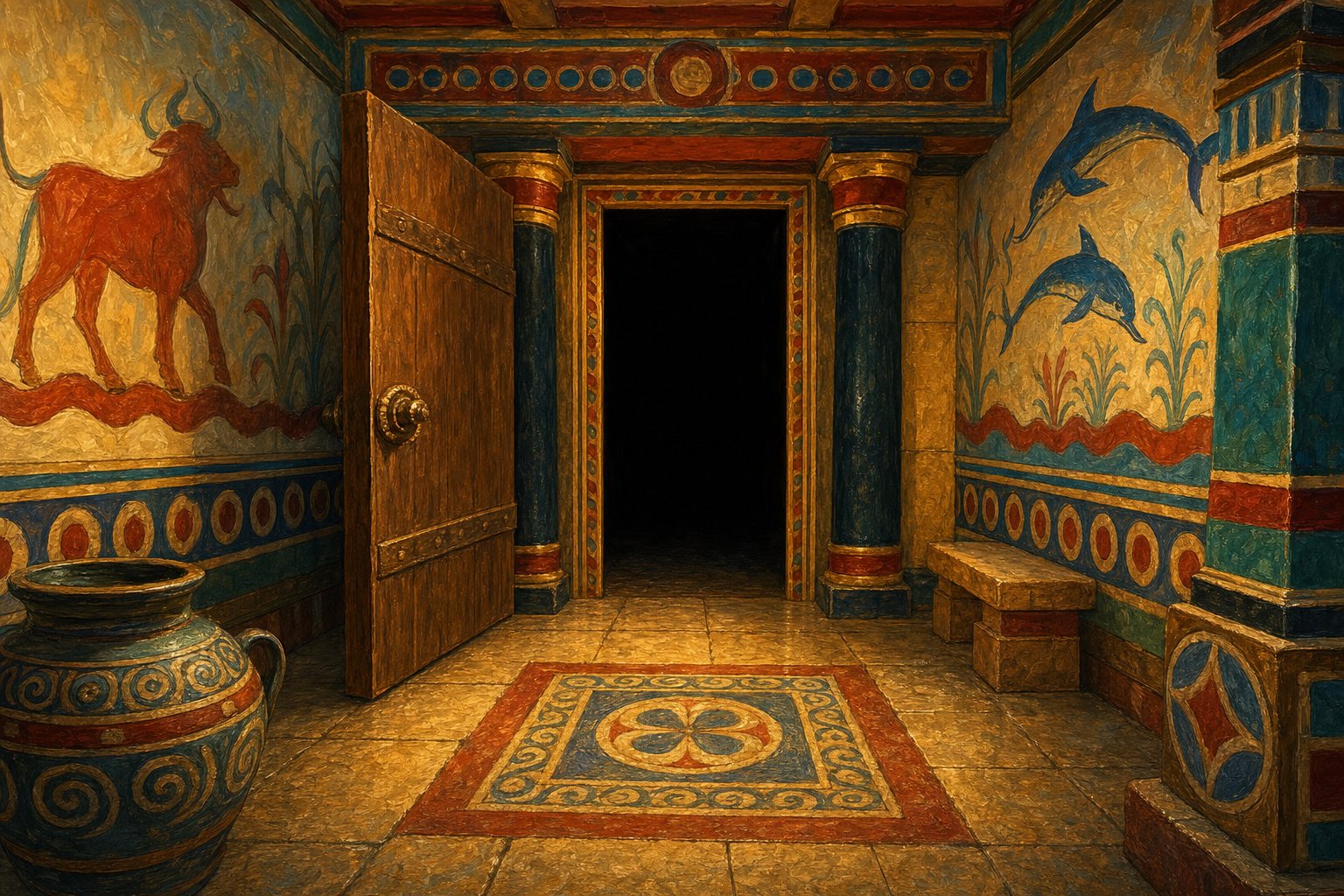
The door is not locked. It is not even shut — it stands a hand's breadth open, and the room beyond it is the first place down here that has no light in it at all, not a lamp, not a coal, not a crack. Water ticks somewhere on stone.
A voice out of the dark, dry and unhurried, says: "Put that out, please. It does nothing for me and it will spoil you for the rest of the way." Then, after a moment: "You are six. You were seven when you came in, or you will be. I lose the tense."
DM summary. A blind man on a twelve-foot chain who has been in this cell long enough to be useful. He is the deck's catch-up mechanism: he will hand a party the Resolution clue they have been walking past for four rooms, and he will tell them the shape of what is waiting at the end without ever telling them which one it is.
Terrain & Features
Battle map: custom map. A 25 × 15 ft cell: a ring, twelve feet of chain, and a scratched wall — sketch it and keep the light low. Browse the book if a page half fits your table better.
- Dimensions. 25 ft × 15 ft, ceiling 9 ft. A cell, not a chamber. The door is in the middle of one long wall.
- Light. None, and he asks the party to keep it that way. He is not bluffing and it is not a trick: light does nothing for him and everything in here is easier to hear about than to look at. A party that douses its lamps and talks to a voice in the dark will remember this room for the rest of the campaign. A party that insists on light finds a thin, filthy, calm old man, and loses about half the effect.
- The ring and the chain. An iron ring set in the floor at the room's centre, twelve feet of chain, and an ankle cuff. The cuff's pin is on the outside. Anyone who touches it works that out immediately; it takes no check and no tools. He knows.
- The drip. A finger of clean water down the back wall into a worn hollow. It is how he is alive. There is also a bowl, and there is food in it, and it is not old, and nobody in this room put it there.
- The wall. Within the chain's reach, the plaster is covered edge to edge in scratches: tallies, a diagram redrawn perhaps forty times, and one word repeated in three alphabets.
- The dark itself. Treat it as a feature. He tracks the party by sound and breath with perfect confidence, names who is standing where, and knows when somebody leaves the room without being told.
Traps / Puzzles / Checks
There is nothing here to defeat. These are the ways in.
| Check | DC | Result |
|---|---|---|
| Insight | 13 | He is not mad, he is not lying, and he is not asking to be rescued. He has decided something and is at peace with it |
| Investigation on the wall | 14 | The redrawn diagram is a route: not a map of the maze, which cannot be mapped, but a sequence of decisions — turn toward the draught, take the stair that goes down before it goes up, never take the third door |
| Medicine | 12 | He has been here between eight and twenty years. He is not starving. Somebody feeds him and it is not out of kindness |
| History or Religion | 15 | The repeated word is a name in the old script, and it is not his |
| Perception | 13 | There is a second bowl, dry, in the far corner, out of the chain's reach. There was another one of him once |
What he wants before he answers. Three things, asked for one at a time, and he will not be hurried through them.
- A name. Not the party's business, not their errand — a name, freely given by one of them. He repeats it once and keeps it.
- A sound from outside. He asks somebody to make one: rain on a roof, a gull, a market, a door in a house they grew up in. Played at the table, by the player, badly, out loud. This is the price and it is worth insisting on.
- A promise. That the party will not tell the people who feed him that they spoke to him. He does not explain and will not be drawn.
What he gives, in order.
- The road. He describes the party's own live Resolution at Sign or Proof tier — whichever is one step ahead of where the drip has got to. He does not name it as an escape; he describes it as a thing he has heard people carry past his door. This is the deck's designated catch-up: if your party has missed three clues in a row, this room fixes it, and you should let it.
- The warning. "There is something between you and it." See below.
- One honest answer to one question about the maze, if they ask well. He will not answer questions about himself.
The Shape at the End
This is the room where a DM can start pointing at the Final Encounter without naming it, and it is the reason this entry exists in the deck. He will not say what waits. He will say what shape it is, once, in one or two sentences, and then refuse to say more.
Pick the line that matches the finale you have chosen. If you have not chosen one, pick the line that suits the run's tone, then let the d20 confirm it — and if the die disagrees, take the DM's once-per-session reroll rather than contradicting him. Every one of the twenty finales sits under one of these six.
| The shape he names | What he says, roughly | Finales it fits |
|---|---|---|
| Horned, and it remembers being called something | "It had a name before they gave it a title. Nobody has used the first one in thirty years and it is still listening for it." | F01, F02 |
| An animal, entirely and only | "There is no bargain in it. It is not cruel. You would not call a winter cruel." | F06, F09, F14 |
| Bronze, patient, and bound by its own rules | "It will not lie to you, it cannot be tired out, and it is obeying an instruction somebody wrote down and then died." | F03, F15, F18, F19 |
| It will speak first, and it can be bargained with | "It will ask you something before it touches you. Most people answer badly. Take the question seriously and it costs you less than the fight." | F04, F11, F13, F16, F17, F20 |
| Below you — in water, or under the floor | "You will hear it before you find it, and you will find it by standing on it." | F07, F12 |
| Many, sharing one will | "When you break one of them, look at the others' faces. That is where the answer is." | F05, F08, F10 |
Do not let him name the room, the boss, or the win condition. His usefulness is that he tells the truth about the category, which lets the players prepare without robbing them of the reveal. If a player asks a direct question, he answers: "I have never been in that room. I have only listened to people who were going to it."
The Chain
He asks not to be freed, and he asks once, without drama.
- Freeing him is trivial. Pull the pin — no check, no tools. Thieves' Tools DC 17 or Athletics DC 18 if a player insists on doing it the hard way, which is its own kind of characterisation.
- What he says: "If I stand up, I will walk. I will walk the way I always walk, and you will follow me because you are decent, and I do not want that for you."
- If they free him anyway: he comes. He walks one room with them, gives them one more true thing — hand out the next clue tier, free — and at the following exit he is simply not there. The chain stays in the party's pack if they took it, and it is a good weight of iron.
- He is not a captive to be rescued and not a maguffin. If the party's Resolution is X05 (Carry Them Out), he is explicitly not the person that Resolution means, and he will say so: "No. Not me. There is a child."
Exits
None. He has a bowl, a chain, and a wall he has written on. Taking any of it would be the single meanest thing available in this deck, and the deck declines to reward it.
Scaling — APL 6 / 12 / 15
| APL | Adjustment |
|---|---|
| 6 | He gives the Resolution clue at Proof tier unprompted and asks only for the sound from outside. All DCs −2 |
| 9 | As written |
| 12 | DCs +1, and he wants a fourth thing: he asks one PC to tell him, truthfully, what they intend to do once they are out. He can tell whether the answer is true |
| 15 | DCs +3, and the food in the bowl is warm. Whoever brings it is one room away and coming back. The party's conversation now has a clock: six minutes of table time, and you should say so by having him tilt his head and stop talking mid-sentence |
- Pacing. Ten to fifteen minutes and every second of it is talking. Behind schedule: skip the three requests, have him give the Resolution clue and the shape-line unprompted, and let the party leave in four minutes. Never cut the shape-line; that is the room's job.
- Run him with almost no description. In the dark, he is a voice and nothing else. Do not describe his face until somebody insists on a light, and when they do, make it disappointing — he is just a man. The disappointment is the point.
- This is the deck's clue-recovery room. If the drip has stalled, if the players have ignored three clues, if you have lost the thread of your own Resolution: this is where you fix all of it, in-fiction, without a contrivance.
- He does not know where he is, and he will say so cheerfully. He knows what goes past his door. That distinction keeps him from becoming a map, which would break the deck.
- Clue drip. Two objects here take a clue well: the diagram redrawn forty times on the plaster, a route made of decisions rather than turns, which is X14 (A Thread of Your Own Making) at any tier; and the second, dry bowl out of the chain's reach, which suits X05 (Carry Them Out) — somebody else was kept here, and they were smaller.
- Table safety. Captivity, blindness, long imprisonment, and a man who refuses rescue. Offer the softer framing before you start: he can be a hermit who chained himself, the cell can be unlocked from both sides, and his refusal can be plain stubbornness rather than anything darker. The room works either way.
- If the party comes back later, he is gone and the chain is neatly coiled on the ring. This is a good thing to mention only if a player asks.