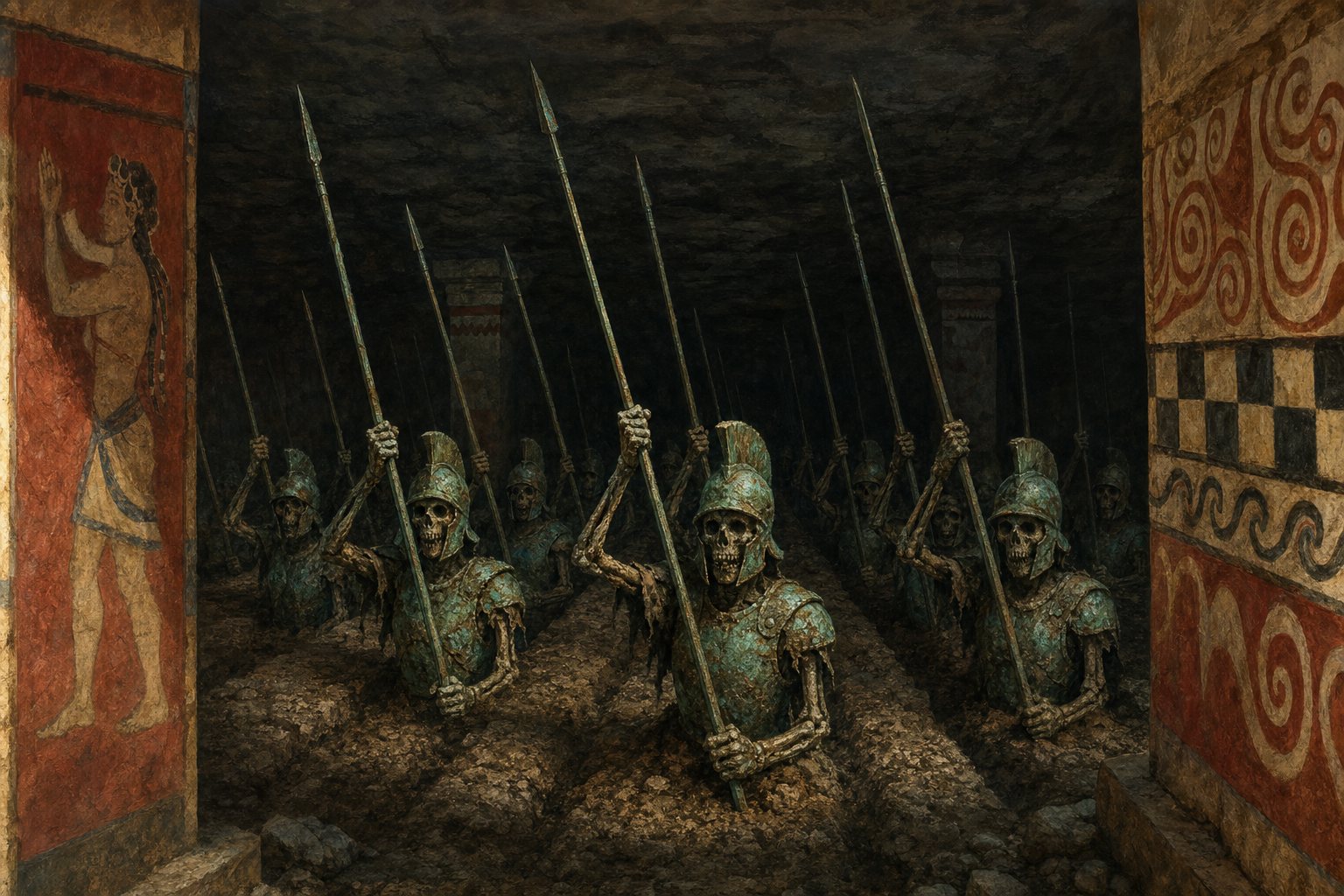
The floor of this cavern has been ploughed. Long straight furrows run away from you into the dark, and out of the furrows, at even intervals, stand men — buried to the waist, arms up, each holding a spear so long it wants two hands and a braced heel. They are bone and bronze and they have been standing here a very long time.
Nothing moves. Then, four rows in, one head turns to follow you, the way a sunflower turns.
DM summary. Nine spearmen planted in rows who cannot take a single step, and sixty feet of open field to cross under their reach. The fight is entirely about which furrow you walk down.
Terrain & Features
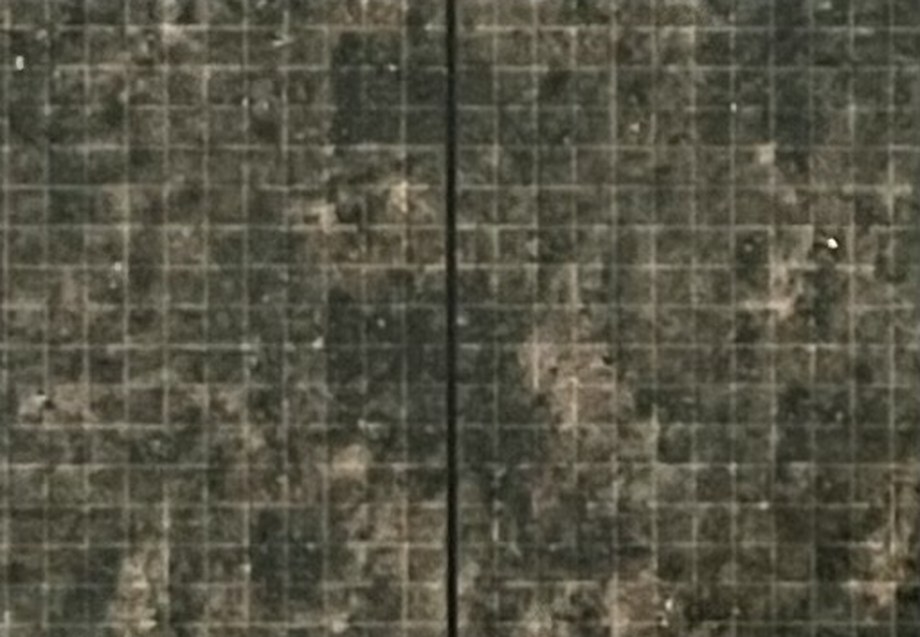
Battle map: The Ashfield — pages 11 & 12, 110 × 75 ft
The ashfield reads as the dark cavern floor at 90 × 60 ft: rule the six east–west furrows 8 ft apart, dot the nine planted spearmen in their staggered grid, and leave the northernmost furrow a stubble of broken shafts.
- Dimensions. 90 ft × 60 ft, ceiling 25 ft — a natural cavern the maze has ploughed. The party enters at the narrow east end.
- Light. None. Bring your own; the room is
cavernousand a torch will not show you the far wall, which is the point. The archers can see further than the party can. - The furrows. Six furrows run east to west, 8 ft apart, each a foot deep and packed with dry earth. They are difficult terrain to cross against the grain and clear walking along it.
- The planted. Nine skeletal spearmen, planted to the waist in the furrows in a staggered grid. None of them can move. They are rooted and they know it. Each carries a 12-ft spear: reach 15 ft, and they get an opportunity attack against anything that enters or leaves that reach.
- The reaped furrow. The northernmost furrow is empty — a stubble of broken shafts where nine more spearmen were harvested by somebody. Walking it puts a character in reach of four spears over the whole crossing instead of twelve. Perception DC 13 to notice from the door, or free once anyone stands in it.
- The ridge. A 6-ft shelf of rock across the west end, above the field, where the archers stand. The stair up it is at the north corner.
Encounter
Six bodies, none of which can chase you, in a room that is sixty feet of open ground.
| Count | Creature | XP each |
|---|---|---|
| 3 | Bronze-Tooth Hoplite | 700 |
| 3 | Bone Archer of the Sown Field | 450 |
Base 3,450 XP; ×2 for six bodies = 6,900 adjusted, against the APL 9 Medium budget of 6,600 — 300 hot, and the archers on the ridge are where that overage sits. This is a forced fight and one of the deck's Medium rooms: the party is expected to walk into it, take some hits, and win. Do not soften it and do not apologise for it.
The other three. Nine spearmen are planted. Only three are animate; the other six are exactly what they look like, which is dead men holding sticks. A character adjacent to one can tell the difference (Perception DC 12, or free when it fails to react to being touched). Until they check, the party has to treat all nine as live, and that uncertainty is the room's real tax.
Round 1. The three animate hoplites do not act until something enters their reach — they have nothing else to do and no way to close. The three Bone Archers on the ridge shoot on initiative from 70 ft, targeting whoever is furthest forward. The archers are the encounter; the spearmen are the terrain.
Tactics. The archers will not come down off the ridge and will not fight in melee: at 5 ft they drop the bow, back up, and die badly. The planted hoplites attack anything in reach, do not move, and cannot be flanked in any meaningful sense — but a creature that steps in and stays inside 5 ft is inside the spear and has advantage against it. Say that out loud the first time a player closes; it is the room's lesson and it should be learned in play, not by a check.
Nothing here pursues. Nothing here can.
Traps / Puzzles / Checks
Reading the field. One Investigation DC 14 from the doorway, taking a minute, tells the party which three are animate — the earth around a live one is loose and freshly turned. This is the room's whole optional advantage and it is worth handing out generously.
Digging one out is possible and pointless: Athletics DC 15 and two rounds to lever a planted hoplite free, at which point it topples and thrashes and cannot stand. A party that works this out has found a legitimate way to remove a spear from the field, and it costs them two rounds under archery to do it.
Exits
None. Everything in this field was planted with what it was buried with: one-piece cast spearheads too brittle to keep, and no coin, because whoever sowed this row took the purses first.
If your party spends ten minutes searching, tell them exactly that. A room with nothing in it is part of the deck's economy — 45 of the 100 rooms give nothing, and the ones that do are worth more for it.
Scaling — APL 6 / 12 / 15
| APL | Adjustment |
|---|---|
| 6 | Two hoplites and two archers; five planted decoys instead of six. All DCs −2 |
| 9 | As written |
| 12 | Four hoplites, four archers, and one Dragon-Tooth Serjeant on the ridge who can move and does. DCs +1 |
| 15 | Five hoplites, four archers, a Serjeant, and the field re-sows: at the end of every third round, one of the six decoys wakes. DCs +3, and the party should be told after the first one that this is now a room they want to leave |
- Pacing: fifteen minutes. When you are behind schedule, cut it to the three archers on the ridge and two live spearmen, tell the party which is which for free, and run it as one crossing under fire. Eight minutes.
- This is a positioning room, so put it on the mat. Six lines, nine tokens, three of them live. It is the cheapest good tactical map in the deck and it works on a blank battle mat with a piece of chalk.
- If one player is dominating the session, this is the room to hand to somebody else: the reaped furrow, the loose earth, and the "inside the spear" trick are all noticing problems rather than damage problems, and they reward whoever is paying attention rather than whoever rolled best.
- Clue drip. Two hooks: the broken shafts in the reaped furrow, cut clean with a bronze saw by somebody harvesting soldiers on purpose (X03, X12), and the northernmost planted decoy, which is wearing a woman's cloak-pin at the shoulder, pinned there recently and deliberately, like a marker (X10, X05).
- Table safety. Men buried to the waist is the image, and it is worth one sentence at a table that finds live burial hard. Softer framing: they are cast bronze figures on posts, sprouted from teeth, never human at all. The mechanics are identical.
- Callback. Sown Bones (W01) fights in ranks and steps into a dead comrade's place. Here they cannot — they are rooted, and the warband's signature tactic is denied to it. A party that has met the shield wall elsewhere should notice how much easier this is, and a DM should let them enjoy that.
Creature Cards
Both belong to Sown Bones (W01) and recur across the deck, so the numbers live in the bestiary. The tactics above are this room's and stay here.
Shared across rooms, so the full cards live in the bestiary: Bronze-Tooth Hoplite, Bone Archer of the Sown Field. Every mention above opens the numbers here on this page.