The Whispering Trapfloor
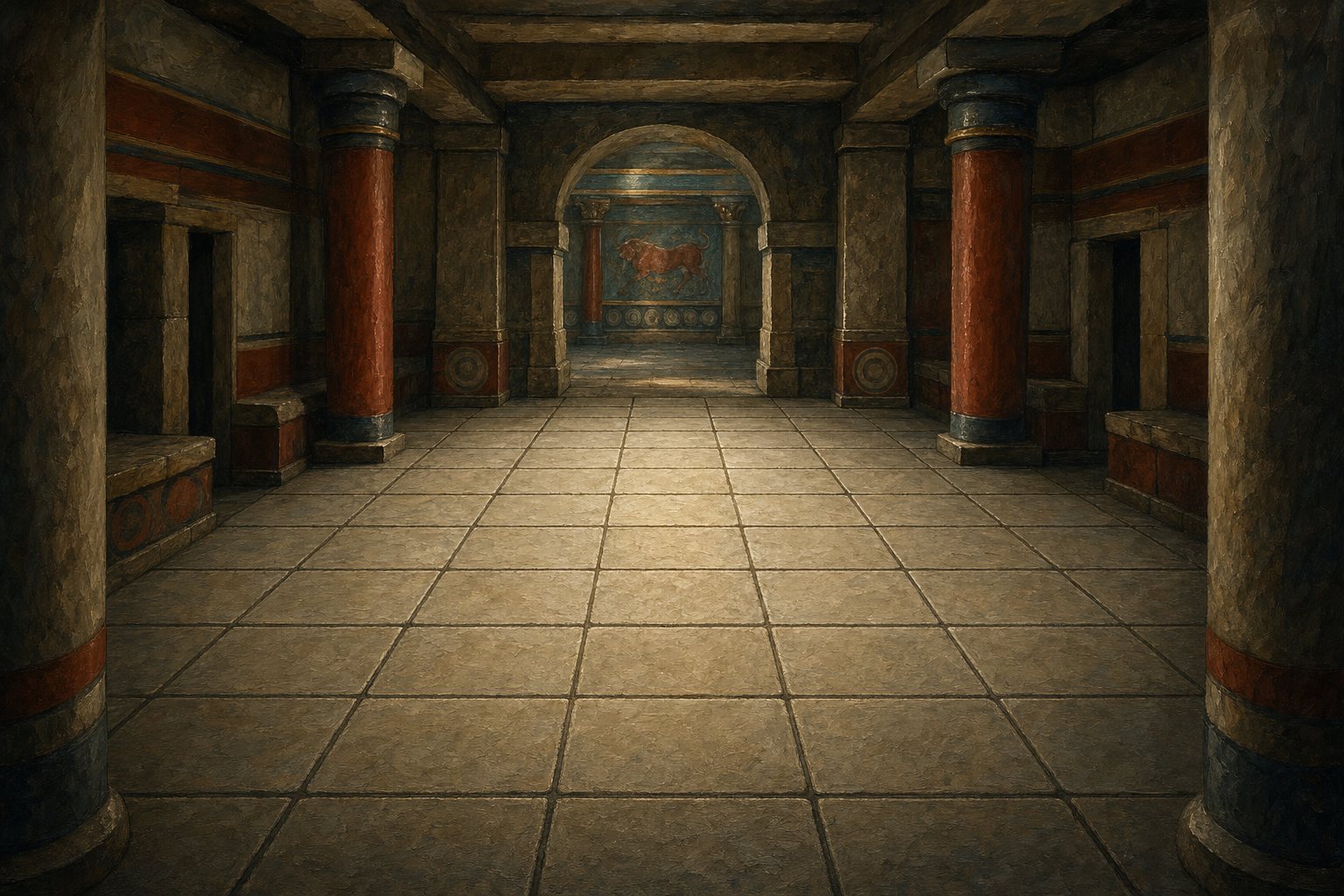
Thirty-five flagstones, seven rows of five, filling the floor between you and the far arch. Nothing is written on them. The mortar lines are clean and even and the whole floor looks exactly like a floor.
As your foot comes down on the threshold, the wall beside your ear says, in a dry voice with no breath behind it: "The third from the left."
It is not a whisper aimed at you. It is a whisper aimed at nobody, said the same way it has been said for two hundred years, into the dark, whether or not there is anybody standing here to hear it.
DM summary. Seven rows of flagstones, a voice that names the safe stone in each row, and two of the seven directions are wrong. The party is told, in the room, that exactly two are wrong, and they can find out which by looking at the floor rather than trusting the wall.
Terrain & Features
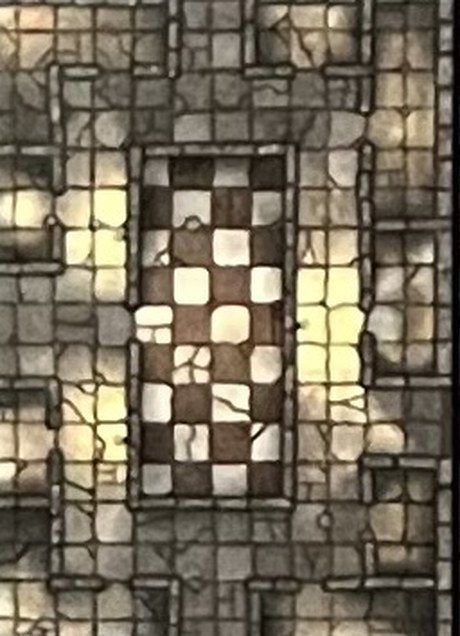
Battle map: The Chequered Rooms — page 23, 55 × 75 ft (one half of The Tiled Halls)
The chequered rooms hand you the grid: mark off seven rows of five tiles as the trapfloor with 5 ft of safe ground at each end, and keep the DM's copy of the safe path on your side of the screen. Wall to 45 × 25 ft.
- Dimensions. 45 ft × 25 ft, ceiling 11 ft. The trapfloor is seven rows of five 5-ft flagstones — 35 ft of floor to cross — with 5 ft of solid ground at each end.
- Light. None, and the room is unkind to it: the flagstones are the same grey as the walls and the wear-marks that solve this room are easier to see by a lamp held low than by a torch held high. Say that if a player thinks to lower their light; it is worth advantage on the wear check.
- The tube-mouths. Four bronze speaking-tube mouths, one at each corner of the room at head height. The voice comes out of all four. The tubes run away into the masonry and whatever is at the other end is not in this room and never appears in this session. Do not stat it. Do not reveal it.
- The mason's tally. Scratched into the door-jamb at hip height: seven strokes, and two of them crossed out. Investigation DC 14, or free for anyone who looks at the doorway before the floor. This is the room's whole gift and it is available before anybody steps anywhere.
- The statue's head. Just inside the threshold: a broken colossal head, limestone, about 80 lb, liftable by one character with both hands. It is the honest fallback and it is sitting there on purpose.
- The wear. Every genuinely safe stone in this floor has been walked on. The safe stones are polished; the trap stones are not, and in a room with no light and no dust the difference is real but subtle.
Traps / Puzzles / Checks
The floor. Twenty-eight of the thirty-five flagstones are hinged plates over a chute. One stone per row is solid.
| Element | Value |
|---|---|
| The voice | Names one stone per row, in order, as a character reaches each row. It is not addressing anybody and it does not repeat itself for a different party member |
| Rows 1, 2, 4, 6, 7 | The voice is correct |
| Rows 3 and 5 | The voice is wrong — the named stone is a plate. Somebody chiselled over the mason's original instruction and re-cut it, and the tally on the jamb records that two of the seven were altered |
| The real safe stones in rows 3 and 5 | Row 3: the far right. Row 5: the centre. (The altered instruction names the second from the left in both cases — the alterer had one idea and used it twice, which is the tell) |
| Reading the wear | Investigation DC 15 per row, or DC 13 with a lamp held at floor level, or passive Perception 16 for a character moving at half speed. A success names the genuinely safe stone in that row regardless of what the voice said |
| Spotting the hinge | Investigation DC 15 at the row's edge: the plates have a hair-line hinge on the far side. Same information, a different skill's worth of the same answer |
| The telegraph | A plate gives half an inch and clicks before it drops. A character moving at half speed gets that click as a full round's warning and may step back with no check at all. A character moving at full speed does not |
| The fall | 4d10 — 15 ft onto a bed of broken pottery in the chute below — with a Dexterity save DC 15 to catch the lip and end up hanging instead of falling |
| Climbing out | Athletics DC 13 from the chute floor to the room above, or a rope from a companion with no check |
| Resetting | A sprung plate re-cocks itself in one minute, audibly |
| The two-phase change | On the fourth plate sprung, the mechanism's counterweight bottoms out. Every plate in the last three rows drops open and stays open: the far half of the room becomes a 15-ft-wide open pit, crossable only by the beam at the edge (Acrobatics DC 14) or by the chute below |
The honest fallback. Carry the statue's head across, dropping it on each suspect stone. Eighty pounds is enough to spring a plate. Two rounds per row to prod, spring, and step — fourteen rounds for the floor — and every plate sprung this way counts toward the four that break the mechanism, so a party who springs everything gets the pit, which is exactly as walkable as the floor was. That is not a punishment. It is a slower, uglier, entirely valid solution and you should let them take it.
The one thing the room will not do is kill somebody who moves at half speed and listens. The click is always there.
Exits
None. Three previous crossers are in the chute, under the pottery, and everything they were carrying went fifteen feet onto a bed of sherds two centuries ago. There is a bent sword, a purse of coin fused green, and a pair of boots somebody would have to be desperate to want. If a player insists on searching, let them find a name scratched inside a belt-buckle and nothing else, because a loot roll here would cheapen what the room is actually saying, which is that the voice has been lying to people for a very long time.
Scaling — APL 6 / 12 / 15
| APL | Adjustment |
|---|---|
| 6 | Five rows, one lie (row 3). Fall 2d10, saves DC 13, and the wear check is DC 12. The tally on the jamb is legible without a check |
| 9 | As written |
| 12 | Nine rows, three lies (rows 3, 5, and 8), fall 10d10, saves DC 16, wear check DC 16. The mechanism bottoms out on the third plate sprung |
| 15 | Nine rows, three lies, and the voice adapts: after the first plate is sprung it begins naming the stone the party's own wear-reading chose, one row ahead, because whatever is on the other end of the tubes can hear them talking. Fall 10d10, saves DC 18, wear check DC 18, mechanism bottoms out on the third plate |
- Pacing. Fifteen minutes. Seven rows is a lot of rows; if the table is enjoying the paranoia, run all seven, and if they are not, run rows 1 to 3, have the third one lie, and let them cross the rest on the strength of having caught it.
- If you are behind schedule, five rows and one lie. Six minutes, and the room still does its whole job — which is to teach a table that information in this maze has an author.
- Deliver the voice flatly. No malice, no hiss, no theatrical pause. It is a dry recitation into an empty room, the same seven sentences it has said a hundred thousand times, and it is not talking to the party. Played that way it is far more unsettling than a taunt, and it also makes the lie feel like vandalism rather than a trick — which is what it is.
- The tally on the jamb is not optional. If nobody looks at the doorway, mention the scratches as they walk past on row one. A trap room whose fairness depends on a check nobody made is a trap room that will kill somebody and be resented.
- Do not let this become fourteen rounds of prodding. Once the party has established a method — half speed, lamp low, wear check, prod the doubtful ones — narrate the remaining rows in one go and ask for two checks, not seven.
- Never reveal what is at the other end of the tubes. No monster, no shade, no cultist behind a grille. The party will invent something worse than anything in the bestiary and they will be right to.
- Table safety. A concealed drop and a fifteen-foot fall onto broken pottery, plus three bodies at the bottom. Mild by this deck's standards; if the table would rather not have the bodies, the chute is empty and the boots are all that is left.
- Clue drip. Two objects: the belt-buckle name in the chute, which is a name the party may have already read on a wall or heard from a shade (X05 or X14, Trace), and the voice heard from inside the tube-run on exit B, where it is audibly saying a different set of instructions to somewhere else in the maze (X14, Sign or Path tier — the tubes are a network, and a party who follows the run has a route that is not a corridor).
- No warband, and nothing lives here. The temptation is to put something at the far end that has been listening. Resist it. The room is thirty-five stones, a dry voice, and the fact that somebody once came in here and re-cut two of the instructions to kill strangers — and that is a more frightening resident than anything with hit points.