Court of Broken Statues
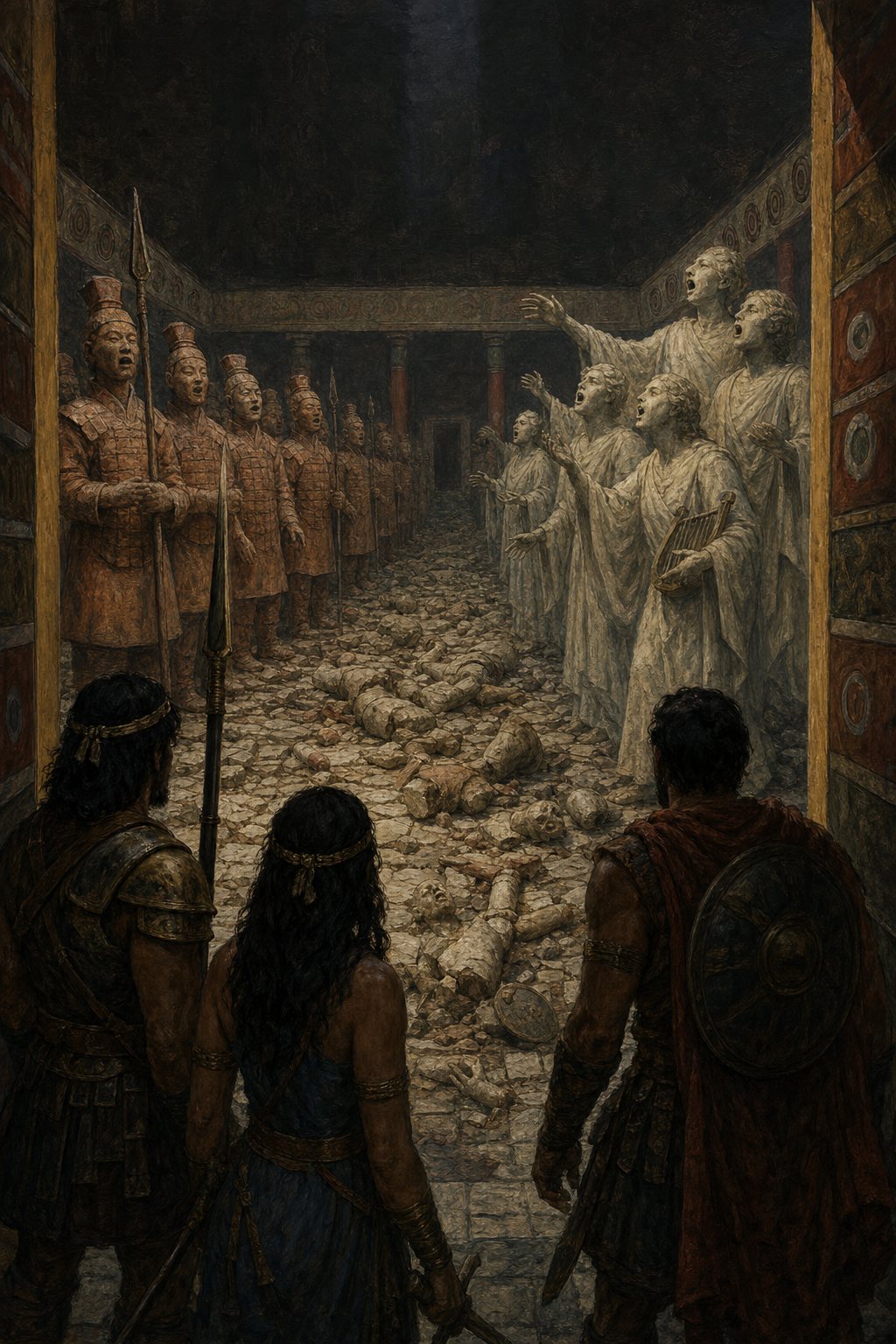
A courtyard, open to a vault so high your light does not find it, and the floor is a century of breakage: arms, torsos, half a face, a hand still holding a spear-butt, heaped and scattered across sixty feet of flagstone. Somebody has been dumping failures here for a long time.
Against the far wall there is a wound-gate — a portcullis of bronze bars with a winch on either side of it and a pressure plate under each winch, worn concave by feet.
A hand near your boot closes.
DM summary. Slow, weak, numerous animated fragments in a room big enough to walk away from them — except the far gate needs two people standing still on two plates, sixty feet apart, for six rounds. The party has to hold ground in a room whose only advantage is that they do not have to.
Terrain & Features
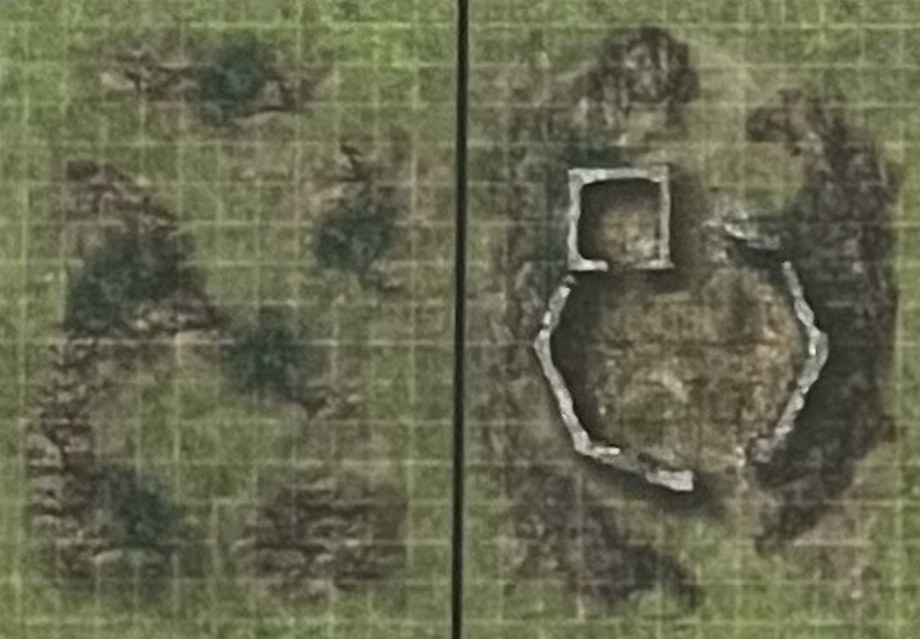
Battle map: The Fallen Steading — pages 7 & 8, 110 × 75 ft
The fallen steading reads as the statue court at 80 × 60 ft: the scree half is the rubble drifts (difficult terrain as printed), the ruined walls are the collapsed colonnade. Chalk the six statue plinths and the wound-gate with its two winches on the west wall.
- Dimensions. 80 ft × 60 ft, ceiling lost in the dark above 40 ft. Cavernous: there is room here to kite, to shoot, and to move, and the party should feel the space as an advantage from the first round.
- Light. None, and the vault swallows it. A torch lights the floor and nothing above; the party will spend the fight unable to see the ceiling, which is atmosphere and nothing more — there is nothing up there.
- The breakage. Rubble across the whole floor: difficult terrain in the marked drifts (roughly a third of the room, in three ridges running east–west) and clear flagstone between them. Anything that moves through a drift makes noise; nothing in this room cares.
- The wound-gate. Bronze portcullis in the west wall, 10 ft wide, currently down. Two winches, one either side, 60 ft apart, each with a pressure plate under it that needs 200 lb to hold — a character in armour, two lightly-built characters, or 200 lb of statue fragments piled on it.
- The six-round wind. With both plates held, the gate winds up at one foot per round and needs six continuous rounds. If either plate lifts, the gate drops back to the floor and the count restarts from zero. That is the room.
- The dry fountain. Centre of the court, a stone basin 12 ft across and 3 ft high: half cover, a 3-ft step up, and the best place in the room to stand.
- Four intact statues. Standing at the court's corners, unbroken, and they are not animate and never become animate. Say so if a player checks. They are the room's only red herring and they are there so the party wastes one action on them.
Encounter
Four cracked soldiers, a floor full of crawling pieces, and a gate that takes six rounds of standing still.
| Count | Creature | XP each |
|---|---|---|
| 4 | Terracotta Soldier | 700 |
Base 2,800 XP; ×2 for four bodies = 5,600 adjusted, under the APL 9 Medium budget of 6,600. The gate clock is the difference and it is worth more than another body: this is a Medium fight that the party could trivially walk away from, made into a real encounter by the fact that two of them have to stand on two spots for six rounds.
Every soldier here is already cracked. Each one has half its maximum hit points and, when it drops, splits into two crawling halves rather than shattering. So: four bodies on the XP sheet, twelve problems on the floor.
The crawling halves. No hit points and no stat block. A half moves 10 ft a round toward the nearest living thing, and if it reaches a creature it grapples one leg — escape DC 12, or one attack, or 5 damage of any kind destroys it. A creature grappled by a half cannot hold a pressure plate, because holding the plate means standing on it and a half will drag a foot off it. That is the whole mechanical point of them.
Round 1. Nothing charges — they cannot. The four soldiers stand up out of the drifts in different parts of the room and start walking, at 20 ft, toward the nearest noise. The first crawling halves are already moving: six of them, from the breakage, before anybody has hit anything.
Tactics. They are slow, they are stupid, and they are relentless. They go for whoever is standing still, which is by definition whoever is on a plate. They do not climb the fountain (a 3-ft step defeats a crawling half entirely — reward the party who notices). Nothing pursues past the court's arches, and if the party leaves by the east side the room simply stops.
Traps / Puzzles / Checks
The gate, stated as a procedure because a DM is going to be tracking two plates and a count at once.
| Element | Value |
|---|---|
| Weight per plate | 200 lb, held continuously |
| Ways to hold one | One armoured character; two light characters; 200 lb of fragments piled on it (four rounds of gathering and stacking, Athletics DC 12, and the pile is stable unless a crawling half is dragged over it) |
| The wind | 1 ft per round, six continuous rounds, both plates held |
| Interruption | Either plate lifts → gate drops, count resets to zero. No partial credit |
| Signal | The winches click once per foot. Everybody in the room can hear the count, which means the players can too — call the clicks out loud |
| Solved state | The gate stands at 6 ft and locks. It does not come down again |
| The fragment trick | A party who piles fragments on both plates never has to stand on either. It takes eight rounds instead of six and it is the correct solution. Let them find it and do not hint — but if they are stuck at round ten, have a crawling half drag a fragment onto a plate and let them watch the gate twitch |
Exits
None. It is a rubbish tip for failed sculpture. There is nothing here but fired clay and marble chips, the four intact statues are worth a fortune and weigh eight hundred pounds each, and the winch chain is fixed. Tell the party what the intact statues would fetch in Knossos and then let them try to work out how to carry one.
Scaling — APL 6 / 12 / 15
| APL | Adjustment |
|---|---|
| 6 | Three cracked soldiers, four crawling halves to start, and the gate needs four rounds and 150 lb a plate. All DCs −2 |
| 9 | As written |
| 12 | Six cracked soldiers, a Marble Chorister that sings from the fountain and sets the order the halves move in, and the gate needs eight rounds. DCs +1 |
| 15 | Eight cracked soldiers, two Marble Choristers, and the breakage itself is a spawner: two new crawling halves per round for as long as any soldier still stands. The gate needs eight rounds and 300 lb a plate. DCs +3 |
- Pacing. Fifteen minutes, and the whole shape is the six-round count. Call the winch clicks out loud — "two feet" — and the room runs itself.
- If you are behind schedule, the gate is already up and the room is four cracked soldiers in a big empty court. Seven minutes, and it is a perfectly good palate-cleanser fight.
- Do not track hit points for the crawling halves. Twelve of them with hit points is a bookkeeping nightmare and a boring fight; 5 damage or one attack destroys one, and that is the whole rule. Use tokens, coins, or dice on the mat and sweep them off as they go.
- The room's real question is "who stands still". Make that explicit in round one by describing the worn concave plates. The party will divide into people who fight and people who hold, and the fun is entirely in whether the holders can be dragged off.
- If one player is dominating, put them on a plate. Six rounds of standing on a pressure plate while somebody else does the exciting part is a very effective and entirely diegetic way to hand the spotlight around.
- Table safety. Nothing to flag. Clay, marble, and no blood — this is the room to reach for after the petrified garden or the drowned nave.
- Clue drip. Two objects: the four intact statues, which are portraits of somebody and are the same four faces the party may have seen depicted elsewhere in the maze (X08, Trace — a court that keeps portraits of a king has a relationship with that king), and the winch chain, whose gearing is a smaller version of the great gate's counterweight rig (X19, Sign — the party is learning the mechanism they will need at the front door).
- Warband callback. Clay & Marble (W16) are slow, many, and hard to move, and this room is the warband's thesis with the difficulty turned down: the party cannot lose the fight, only the clock. A table who met the choristers in the marble hall should recognise the ranks-and-patience feel immediately and should be pleasantly startled to find they have room to run.
Creature Cards
Terracotta Soldiers belong to Clay & Marble (W16) and recur across the deck, so the numbers live in the bestiary. The half hit points, the splitting, the crawling halves, and the gate clock are this room's and stay here. The Marble Chorister appears only in the APL 12 and 15 rows and is listed so a DM scaling up has the card to hand.
Shared across rooms, so the full cards live in the bestiary: Terracotta Soldier, Marble Chorister. Every mention above opens the numbers here on this page.