Court of the Thread-Wardens
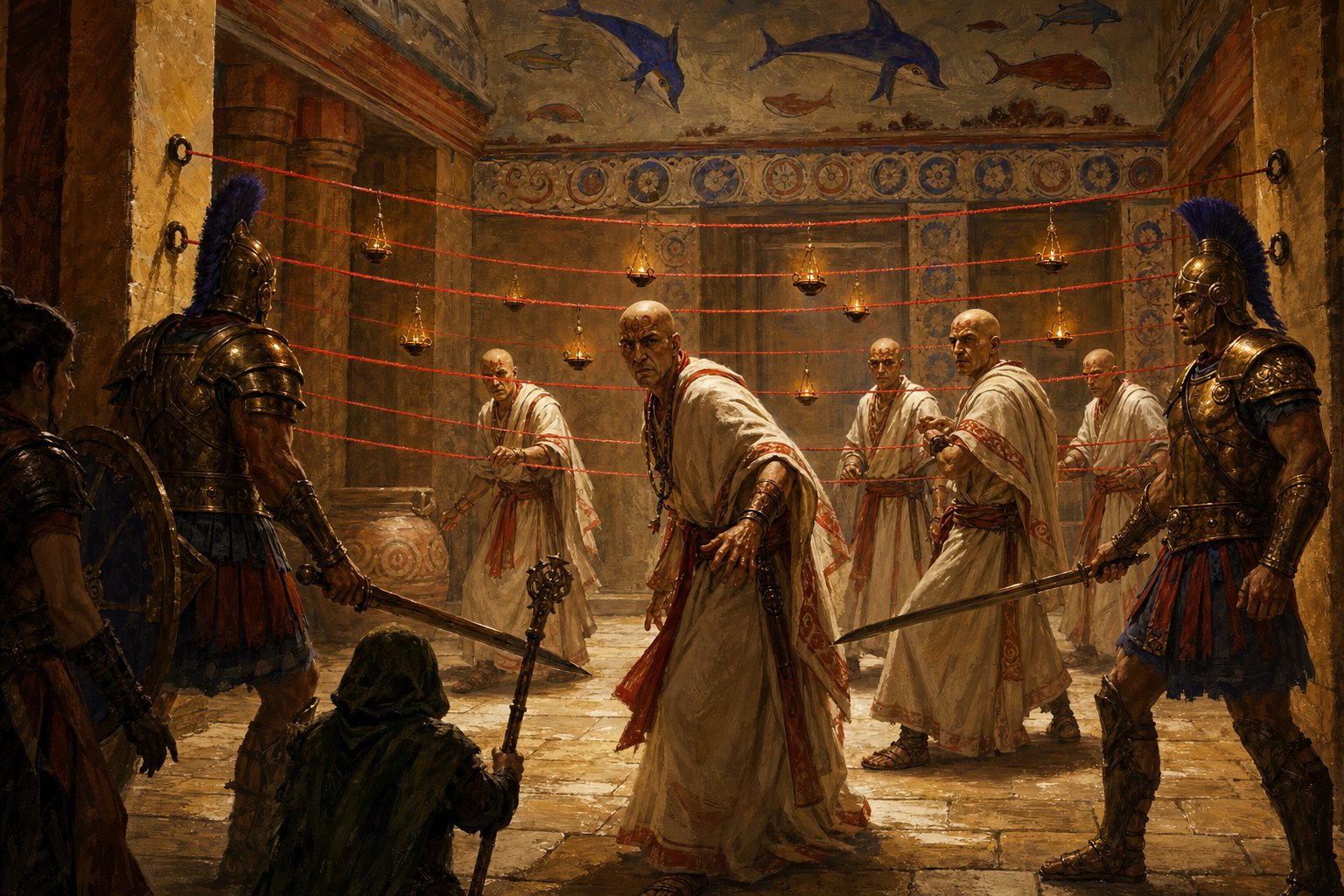
An old courtyard with the sky bricked over. Nine lines of red wool cross it at waist height, taut, running wall to wall through iron rings, and from each line hangs a small clay lamp — nine little flames in the dark, strung like washing.
Four people in grey stand under them with bone needles in their hands, working knots. A fifth, older, is winding a spool and does not look up as you come in. "Wait," he says. "You'll have it in your hair."
DM summary. The Cult's splicing station, where they cut Ariadne's line and re-tie it into their own routes. They fight standing in a cat's cradle they can re-string on the fly, and every thread the party cuts takes one of the nine lamps with it.
Terrain & Features
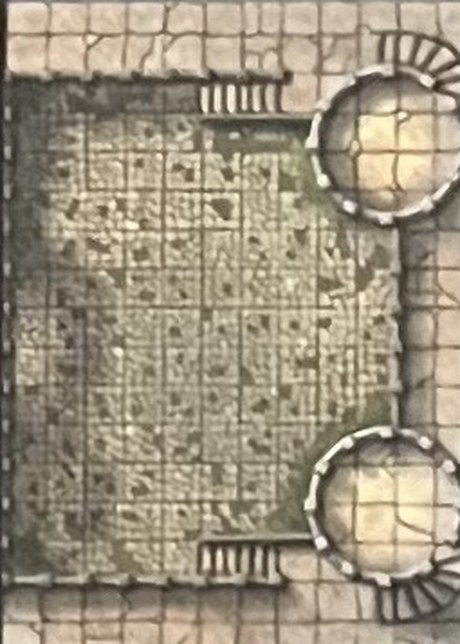
Battle map: The Garden Court — page 42, 55 × 75 ft (one half of The Small Keep)
The garden court is the thread court at 50 × 50 ft: the wall line is the colonnade (chalk column dots along it), then rule the nine waist-high threads wall-to-wall — dry-erase lines you wipe as each is cut. Mark the splice bench north.
- Dimensions. 50 ft × 50 ft square court, ceiling 25 ft, colonnaded on all four sides with a 5-ft walkway behind the columns. Entry is at the south-west corner.
- Light. The nine lamps and nothing else. Bright in the middle, dim at the columns. Each thread cut or burned drops its lamp: the lamp smashes, the oil burns out over one round, and the room loses one step of light. At three lamps left the court is dim throughout; at zero it is dark and the wardens, who have worked here for years, do not care.
- The nine threads. Waist height, wall to wall, dividing the floor into a grid of lanes. Crossing a thread costs 5 ft of movement; running through one is an Acrobatics DC 12 or you go down prone with a lamp swinging over you. A thread has AC 11 and is severed by any slashing hit or 1 fire damage.
- The rings. Iron rings set into the walls at 3-ft intervals — sixty of them, which is why the wardens can re-string a line anywhere they like.
- The splice bench. A trestle at the north end holding spools of dyed wool, bone needles, a knife, and a coil of thread that is not theirs: finer, older, and dyed a different red. This is the room's clue and its loot.
- The dry basin. A stone lustral basin sunk two steps down in the north-east corner, 10 ft across — the only ground in the room no thread crosses, and thus the only place a spellcaster can stand without a lamp over their head.
Encounter
Three wardens working the lines, one priest working the spool, and a court they can re-shape every round.
| Count | Creature | XP each |
|---|---|---|
| 3 | Thread-Warden | 1,100 |
| 1 | Knossian Priest of the Thread | 1,800 |
Base 5,100 XP; ×2 for four bodies = 10,200 adjusted, against the APL 9 Hard budget of 9,600. Six hundred over, and it plays harder than that because the wardens choose the terrain every round and the party is fighting in a room that keeps getting darker.
The re-string. Once per round, on their turn, each warden may cut one thread and re-tie it at another pair of rings as part of their movement. The cut lamp falls: anything under it makes a Dexterity save DC 13 or takes 1d6 bludgeoning, 1d6 fire, and is prone in burning oil that lasts one round. The re-tied line is then in the party's way instead of theirs.
Round 1. Nobody attacks. The priest finishes his winding, says "you'll have it in your hair" a second time, and then names the party as thread-cutters — his curse lands on whoever is holding a blade nearest a line. The wardens cut the three southern threads simultaneously, which drops three lamps into the party's entry lane and turns the south quarter of the court into a dark, burning tangle. That is the ambush and it is the only free round they get.
Tactics. Wardens fight in the lanes and never in the open: each one keeps at least one taut thread between itself and the nearest melee weapon. They will not cut the north three threads, ever, because those are the spliced line and their work. The priest stays behind the bench, blesses whoever is losing, curses whoever cuts wool, and — this matters — he negotiates when he is losing. At half the wardens down he offers passage. Take the offer if the table is behind schedule.
Bypass Options
The Cult is a Cult before it is a garrison, and it is desperate to be recognised. A character who has seen a Cult splice before, or who studies the bench (Investigation DC 13), can tie a square knot in a piece of wool and hold it up. Religion DC 15 or Deception DC 15 to carry it off — advantage if the party is carrying any red thread at all.
- Success: the priest calls the wardens off, walks the party across the court himself, and talks the entire way about how the maze should only be walked by the initiated. He gives them nothing else and he does not let them near the bench.
- Failure: he asks a follow-up question about the rite and the answer is wrong. No fight yet; the wardens take up the lanes and the party has one round to leave or commit. A second failure starts the fight with the priest already cursing.
- Cost: you cannot take the bench's contents by this route and you do not get the loot roll. Passage is not plunder.
The spool the priest is winding is the room's real object, and everyone in grey knows it. Spot it as load-bearing with Investigation DC 14. Sever it with a ranged attack (AC 13), Sleight of Hand DC 15 from adjacent, or any fire on the bench.
- Success: the whole north half of the cat's cradle goes slack at once. The wardens stop fighting and go for the falling line — all three, immediately — because a dropped splice means hours of work and a corridor they can no longer find. The party has three rounds of a completely empty court.
- Failure: the priest gets a hand to it. He now stands on the bench with the spool held over the nearest lamp flame, and he will burn it before he lets the party have it — which costs him the corridor and costs the party the clue.
- Withdrawing instead: the wardens do not pursue past the colonnade. The priest calls one insult after the party and goes back to work. They lose the roll, the clue, and nothing else.
Traps / Puzzles / Checks
Reading the splices is the most valuable thing in this room and it is free once someone looks. Investigation DC 13 at any knot on the bench, or on any thread in the court:
| What they see | What it means |
|---|---|
| Square, sailor-neat, pulled tight with a needle | The Cult's work. Every one of these leads into Cult corridors |
| Asymmetric, tied one-handed, a weaver's knot | Hers. There are exactly two in this room, both on the fine old coil at the bench |
| A cut end laid neatly beside its partner | Somebody tidy cut this line on purpose and did not want it to look cut |
Once a character has made this check they recognise Cult splices anywhere in the maze for the rest of the session with no further roll. Say so at the table — it is a permanent, portable, mechanical reward for curiosity, and it is the single most useful thing R026 gives anybody.
Exits
One roll on the loot table, earned by taking the bench: the spools, the bone needles, the knife, and the offering-box under the trestle. Either win the court, or lift the box while the wardens are chasing the dropped master line (Sleight of Hand DC 13 during those three rounds).
The fine old coil of wool is not loot. It is forty feet of somebody's thread with two weaver's knots in it, it belongs to Resolution X10, and it goes on the party's sheet as a clue object rather than as treasure. If the party sells it to a shade later, that is their business and their loss.
Scaling — APL 6 / 12 / 15
| APL | Adjustment |
|---|---|
| 6 | Two wardens, one priest, six threads instead of nine. Wardens re-string every other round. DCs −2 |
| 9 | As written |
| 12 | Four wardens and two Lost Cohort Hoplites who hold the north colonnade and do not move from it. DCs +1, and the falling-lamp save is DC 14 for 2d6 fire |
| 15 | Five wardens, two priests, and the lamps are naphtha: a dropped lamp leaves a burning 10-ft square for three rounds. The wardens re-string twice per round. DCs +3 |
- Pacing: eighteen minutes for the fight, eight if they talk. The priest's surrender offer at half strength is your pacing valve — use it without shame when the table is behind, and let the party walk out having won an argument.
- Draw the nine lines. Actually draw them, on the mat, in red. The room is a positioning puzzle and it does not work in the head. If you have no mat, run six threads instead of nine and describe them as three each side of a central aisle.
- The lamps going out is the drama. Count them down aloud: nine, seven, four. A party fighting in the dark against people who work here is a different fight, and they should be able to see it coming and choose to stop cutting.
- If a player is dominating, the wardens re-string around them: they will happily wall a barbarian into one lane with three threads and fight the rest of the party at leisure. It is the most characterful thing they do.
- Clue drip. This is the strongest X10 room in the deck outside the Resolution itself, and the two objects are the fine old coil with the weaver's knots and the priest's route-tally scratched on the bench edge, which counts splices rather than corridors (X14 for a party doing their own mapping).
- Callback. The Cult of the Thread (W18) turns up in a temple, on a stair, at a throne, and in a camp. They are the maze's only faction with an argument, and they always make it. A party that has met them should recognise the square knot before you describe it.
Creature Cards
Both belong to the Cult of the Thread (W18) and recur across the deck, so the numbers live in the bestiary. The re-string, the lamps, and the splice-reading are this room's. The Lost Cohort Hoplites in the APL 12 column have their card in the bestiary too; pull it if you scale up.
Shared across rooms, so the full cards live in the bestiary: Thread-Warden, Knossian Priest of the Thread. Every mention above opens the numbers here on this page.