Throne of the Absent King
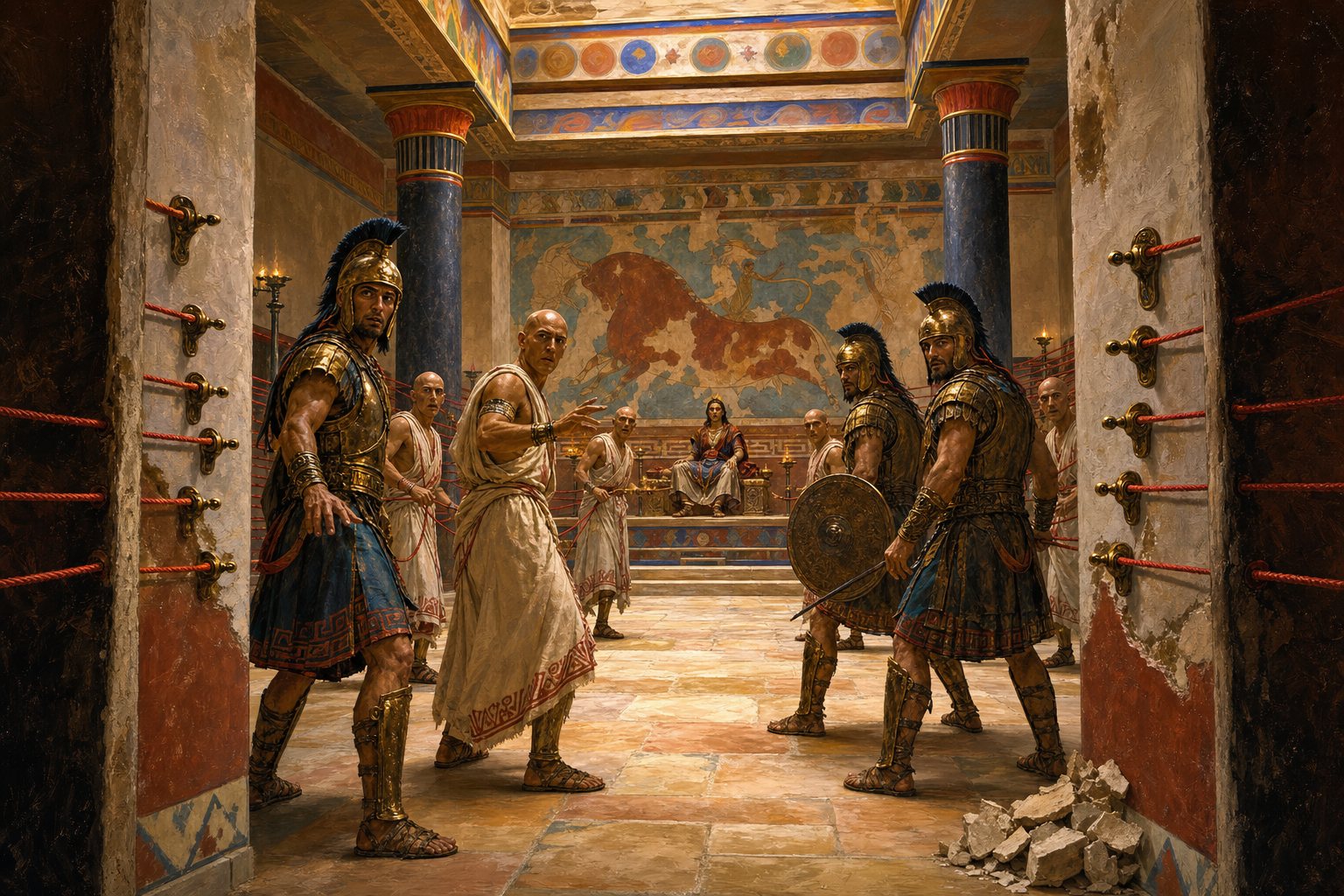
An audience hall, and it has been kept. The floor is swept. The lamps are trimmed. Red thread has been strung from bracket to bracket down both walls in neat parallel runs, and where the plaster has fallen someone has swept the pieces into a pile in the corner rather than leaving them.
At the far end, up three steps, there is a gypsum throne with a footstool in front of it and nobody in it. A man in a bronze cuirass stands to the right of the empty chair with a staff in the crook of his arm. He watches you come in, waits until you have stopped, and says: "His Majesty will hear you. Approach the mark and be brief."
DM summary. A steward who has kept a dead audience running for twelve years, and who will grant passage to anyone who petitions correctly. The room is a protocol problem, and the protocol is written on the walls.
Terrain & Features
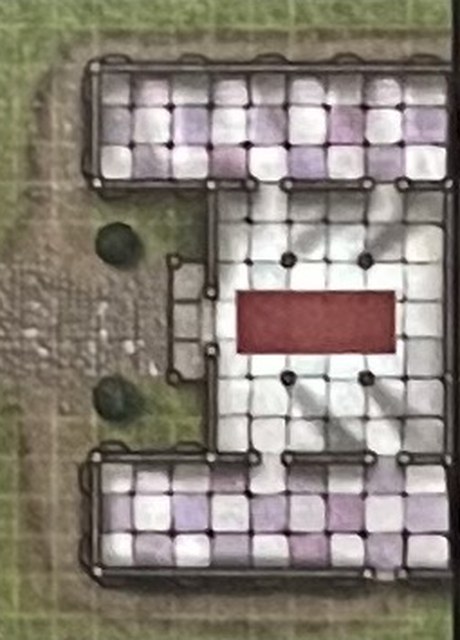
Battle map: The Great Room — page 43, 55 × 75 ft (one half of The Villa)
The villa's great room is the throne hall: the carpet runs to the dais like it was woven for it. Draw the dais and throne at the west end, the six red thread-runs at chest height across the midpoint, and the petitioner's mark 15 ft out.
- Dimensions. 60 ft × 40 ft, ceiling 20 ft, with a dais at the west end three steps up.
ruined-temple: this hall is older and better built than the maze that swallowed it. - Light. Bright. Eight lamps, all lit, all trimmed. Somebody walks this room with an oil jar every day, and that fact should unsettle the party more than any monster.
- The petitioner's mark. A worn patch of floor 15 ft from the dais steps, rubbed smooth by generations of sandals. Standing on it is correct. Standing past it is not, and Hylas will say so once.
- The thread-runs. Red thread strung wall to wall in six parallel lines at chest height across the hall's midpoint — one line per year of the king's absence. Not a trap: a record, and in a fight, difficult terrain the Cult's own people ignore and the party does not.
- The fresco and the tablet. Twenty feet of painted petitioners on the north wall, every one of them kneeling with empty hands, facing the chair rather than the man beside it — and a wax tablet on a stand by the mark with the formula of petition written out in full, because the steward has to prompt people who have forgotten it.
- The chair. Gypsum, unrepaired, with a crack across the seat and dust in the crack. Nobody has sat in it for a long time, and pointing that out is the one thing that starts the fight.
Encounter
Contingent. This is the failure branch, and the room gives the party three ways never to see it.
| Count | Creature | XP each |
|---|---|---|
| 1 | Hylas, Steward of the Empty Chair | 2,300 |
| 2 | Thread-Warden | 1,100 |
Base 4,500 XP; ×2 for three bodies = 9,000 adjusted, against the APL 9 Hard budget of 9,600. It sits 600 light, and the thread-runs are the difference: the Cult moves through them freely and the party does not.
What starts it. Exactly three things, and Hylas warns about all three before any of them can happen:
- Stepping past the petitioner's mark without leave.
- Addressing him as king, or the chair as furniture.
- Saying out loud that the king is dead, or gone, or never coming back — which is true, and he knows it, and that is precisely why he cannot allow it to be said in this room.
Round 1. Hylas does not draw first. He says "You will withdraw" — one warning, one round — while the two Thread-Wardens step out from behind the dais pillars and cut the thread-runs, which drop across the hall and tangle the floor. If the party is still there at the top of round 2, he comes down off the dais and fights properly.
Tactics. He fights to remove the party, not to kill it: he targets whoever is closest to the dais, stays between the party and the chair, and lets anyone retreating toward the door go. The Thread-Wardens re-tie the runs behind the party to cut off the retreat, then flank. Below a quarter of his hit points Hylas stops fighting, plants his kopis, and resumes the audience formula from the beginning — and a party that plays along at that point gets the passage they came for, and a story.
Bypass Options
The intended path, and it costs nothing but attention. The room tells the party how three separate times.
- What "correct" means: stand on the mark, address the throne and not the man, keep your hands visible and empty, and ask leave rather than passage.
- Three accepted forms, any of which works with no check:
- "Minos, King of Knossos, we ask leave to pass through your house."
- "Steward of the Empty Chair, carry our petition: we ask the King's leave to go on."
- Kneeling on the mark in silence with open hands, and letting Hylas prompt them through the formula — which he will do, patiently, because it is his job.
- A clever fourth: accept anything that treats the chair as occupied and the steward as a functionary. Persuasion or History DC 13 covers a fumbled attempt, and History DC 13 or Religion DC 12 lets a character recall the formula outright before they open their mouth.
- Success: he turns to the empty chair, listens to nothing for four full seconds, turns back, and says "His Majesty grants it." Then he opens exit C himself and wishes the party well, and he means it.
- Failure: one wrong form is a correction, not a fight — "You will address the Chair." Two, and he ends the audience and requires the party to leave the way they came, still without violence. Three, or any of the three triggers above, is initiative.
Anything bearing a Knossian palace mark — a steward's inventory stamp, a wax seal, a household token, a writ — is a credential in this room, and there are several such objects scattered through this maze.
- Presenting it: lay it on the footstool. No check if the mark is genuine; Deception DC 16 if the party is passing off something else, and Hylas has twelve years of practice at exactly this.
- Success: he treats the party as household staff on the King's business, which is better than a petition — he grants passage, answers two questions about the maze truthfully to the best of his knowledge, and gives them a lamp.
- Failure: a detected forgery is an insult to the Chair. That is trigger 2, and it is initiative — but he still offers the one-round warning first.
Hylas conducts a full audience every day whether anybody is there or not, and while he is facing the chair he is not facing the room.
- Doing it: stay on the mark and wait twelve minutes of in-world time, or slip along the south wall behind the thread-runs: group Stealth DC 14, at disadvantage for anyone in metal armour, because this floor is swept and this room is bright.
- Success: the party reaches exit A or B unremarked. He notices later and does not care; nobody transgressed against the Chair.
- One failure: he turns and asks, reasonably, whether they intend to petition — the parley is fully open and nothing is lost. Two failures: contempt of the audience, one warning, then the fight.
- Withdrawing instead: the party may withdraw through their own entrance at any stage, including mid-fight. Hylas will not follow — he cannot leave the Chair unattended — and the cost is a wandering-threat roll and this room's clue.
Traps / Puzzles / Checks
Reading the protocol. Three sources, any one enough, none hidden: the fresco (Perception DC 11 — everyone painted here kneels to the chair, not the steward), the audience tablet on its stand (Investigation DC 12 — the formula in the steward's prompt-hand), and the petitioner's mark, which needs no check because it is the most worn thing in the room.
Reading Hylas. Insight DC 14: this man knows exactly what he is doing, knows the chair is empty, and is holding something together with both hands. Nothing about the room changes. How your players treat him might.
Exits
None. Everything here is the King's, the Chair's, or Hylas's, and the man who does the inventory is watching. If a player pries a lamp bracket off the wall behind his back, let them have it, and let Hylas notice on the way out and say nothing at all.
Scaling — APL 6 / 12 / 15
| APL | Adjustment |
|---|---|
| 6 | Hylas alone, and he fights at −25% hit points and without Word of Office. Protocol DCs −2, and he prompts the formula unprompted |
| 9 | As written |
| 12 | Hylas, three Thread-Wardens, and a Knossian Priest of the Thread who blesses him and curses whoever cut a thread-run. DCs +1 |
| 15 | As APL 12, plus Hylas gains +50% hit points, a second phase — at half health he takes the throne, sits in it, and fights from the dais as though he had every right — and a lair action: on initiative count 20 the thread-runs re-tie themselves across the hall. DCs +3 |
- Pacing: fifteen minutes talked, thirty fought. When you are behind schedule, have Hylas prompt the formula in his second sentence — "Approach the mark. Address the Chair. Ask leave" — and let the first player who plays along end the room. Six minutes.
- Play him straight and play him well. He is not mad, not lying, and not a villain; he is a functionary who kept doing his job after the institution around him died. If a player is cruel about the empty chair, do not punish them mechanically — let his voice go flat and let him do his job anyway. That lands harder than initiative.
- Do not let a bad Charisma roll cost the room. Every bypass has a no-check path: the mark is visible, the tablet is legible, and the steward prompts. A party with no face character gets through by kneeling and shutting up.
- Clue drip. Two hooks: the audience tablet, whose lower entries list petitions from people the party may be looking for (X05, X10), and the thread-runs themselves — six lines, six years, all of them tied off at the north bracket by the same knot, which is the Cult's own way of measuring the maze (X14, X19).
- Callback. The Cult of the Thread (W18) cut and re-tie the maze's guiding threads, and here you see what they think the threads are for: a record, kept for a king. A party that has fought them and only seen the tactic should leave this room understanding the belief behind it.
Creature Cards
The Thread-Wardens belong to the Cult of the Thread (W18) and recur across the deck, so their numbers live in the bestiary. Hylas exists in this room and nowhere else, so he is printed here.
Shared across rooms, so the full cards live in the bestiary: Thread-Warden. Every mention above opens the numbers here on this page.
Hylas, Steward of the Empty Chair
Medium humanoid (Knossian cultist), lawful neutral · CR 6 (2,300 XP)
AC 17 (bronze cuirass, ceremonial hoplon) | HP 97 (13d8 + 39) | Speed 30 ft.
Saves Wis +6, Cha +7 · Skills History +5, Insight +6, Persuasion +7 · Passive Perception 13
Protocol Is Armour. While Hylas stands on the dais he has advantage on saves against being charmed or frightened, and he will not attack a creature that has petitioned the Chair correctly, even one fighting his own wardens.
Twelve Years of Practice. He ignores difficult terrain created by the thread-runs and the rubble on the dais steps.
Multiattack. Hylas makes three attacks with his ceremonial kopis.
Ceremonial Kopis. Melee weapon attack, +7 to hit, reach 5 ft, one target: 1d8 + 4 slashing damage.
Word of Office. One creature within 30 ft that has spoken over him: Wisdom save DC 15, taking 2d8 psychic damage and unable to speak until the end of its next turn on a failure, half damage and no silence on a success. Recharges on a 5 or 6 at the start of his turn.
Keep the Dais. Hylas moves up to 15 ft toward the throne without provoking opportunity attacks.
Correct the Record. When a creature within 30 ft makes a Charisma check, Hylas gives it disadvantage. Once per round.