Ruin of the Old Temple
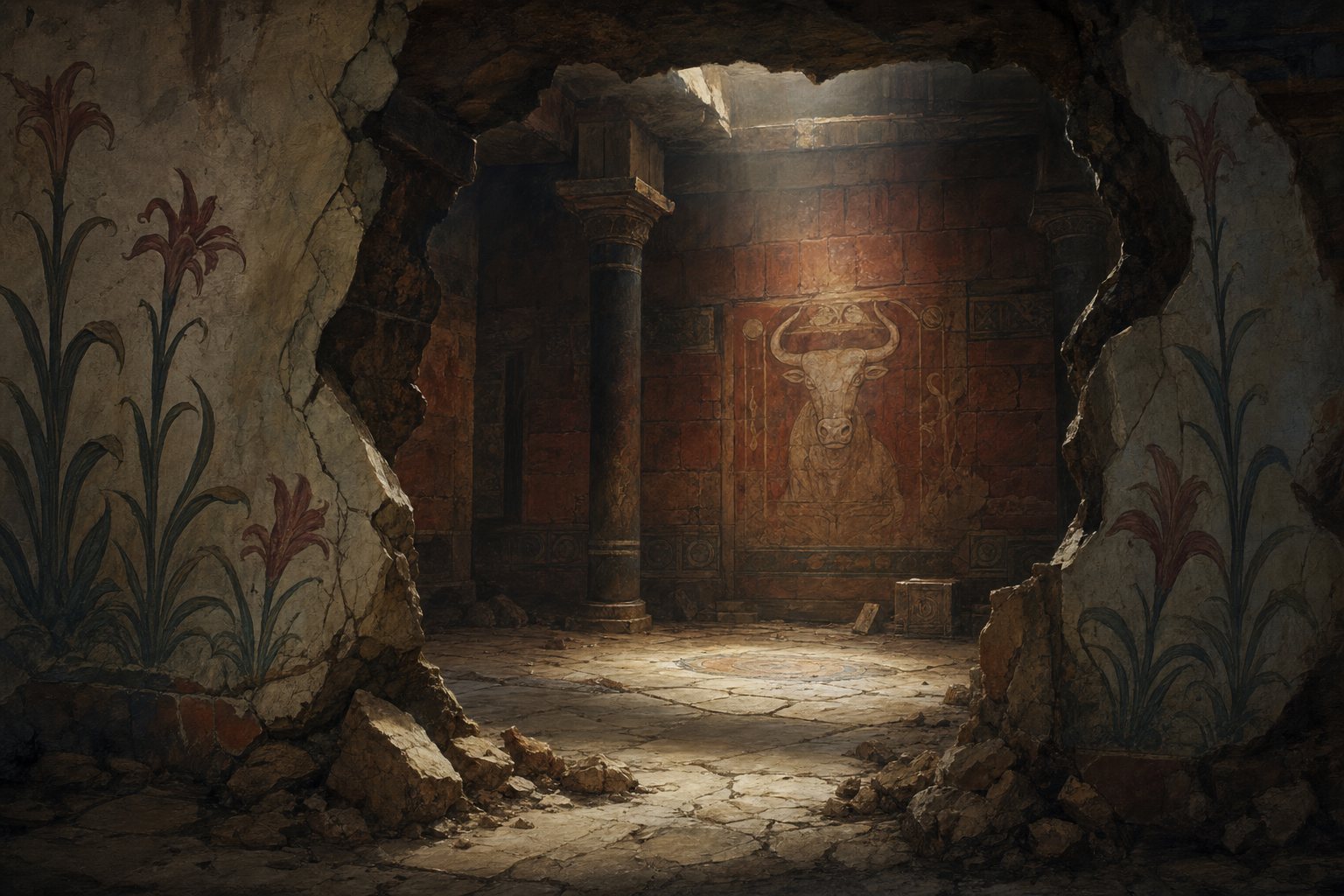
The maze stops being the maze here. The walls change from cut limestone blocks to a older, redder stone, and the corridor you came down does not meet this room so much as break into it — the doorway is a hole smashed through a wall that was painted, once, with lilies.
Inside: four squat pillars holding up what is left of a roof, an offering table worn into shallow cups by hands, and a double axe of green bronze standing in a socket between the pillars, taller than a man. Somebody has been here recently. There is barley in the bowl and it has not gone bad.
DM summary. A shrine that was already ancient when the Labyrinth was dug around it, and the room where a DM can explain what the Labyrinth is without lecturing anybody. Nothing here is hostile. The Cult of the Thread keeps this place, and they are somewhere else right now.
Terrain & Features
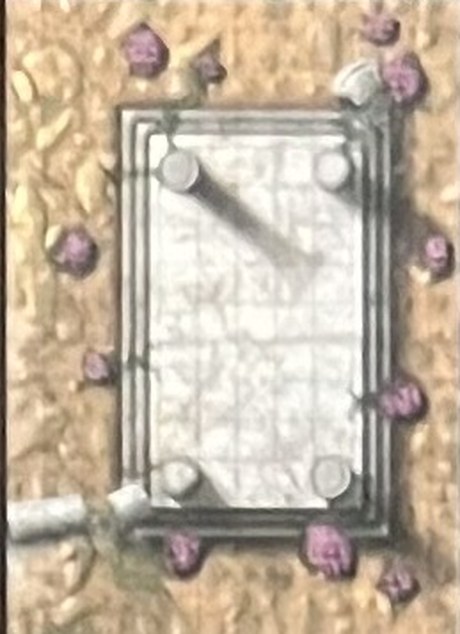
Battle map: The Broken Shrine — page 52, 55 × 75 ft (one half of The Temple on the Strand)
The broken shrine is the old temple: the ruined marble floor is the surviving cella — the printed fallen column included — and the sand reads as the collapsed void (treat it as rubble). Draw the four downward-tapering pillars and the labrys socket at centre.
- Dimensions. 30 ft × 30 ft, ceiling 12 ft where the roof survives and open to a collapsed void where it does not. The maze's corridor enters through a hole in the east wall that was clearly made with picks.
- Light. Four clay lamps on the pillar bases, three of them lit, filled with good oil this week. Somebody tends them.
- The four pillars. Squat, red, tapering downward in the old style. Each is carved with the same sign at eye height: the double axe. They are structural and they are load-bearing for the maze above as well; do not let a player knock one down without consequences you have decided on first.
- The labrys. A double-headed axe of green bronze, 7 ft tall, standing in a stone socket. It is a sign, not a weapon — no edge, and the haft is a fixed shaft of the same casting. It does not come out of the socket. It is the most photographed object in the deck and players will absolutely try.
- The offering table. Limestone, waist high, its top worn into thirty shallow cups by generations of thumbs. In them: barley, a fig, a bronze ring, three teeth, and a knot of red wool.
- The broken light-well. Above the table, the old roof had a shaft. It is blocked forty feet up with maze rubble and masonry — you can see the join where the newer stone was poured in. Cold air still finds its way down. It is the only thing in this room that points at the sky.
- The cult's thread. A single line of red wool runs from the north-west pillar, through the smashed doorway, and away up the corridor. It is knotted every arm's length, and the knots are square and sailor-neat.
Traps / Puzzles / Checks
Nothing here will hurt anybody. These are the four things the room will tell a party who asks it properly, and you should hand out at least two of them free if nobody rolls well.
| Check | DC | What they learn |
|---|---|---|
| Religion | 13 | The sign on the pillars is the labrys. This is the Lady of the Pillar's house, and the word "labyrinth" is her axe's word — the maze is named after this room, not the other way round. The maze is a building put on top of a shrine |
| History | 14 | Two building phases in the east wall: the first maze-builders went carefully around this room and buttressed it, and somebody a century later drove a corridor straight through the wall. Whatever the Labyrinth was for at the start, it stopped being for that |
| Investigation | 15 | The light-well over the table was cut to catch the sun at one particular hour, and it is now plugged with maze fill. The plug is forty feet of rubble and the cold draught coming past it is coming from outside |
| Survival or Nature | 14 | The draught from the light-well carries dust, not damp, and it strengthens and slackens on a slow cycle. That is weather. That is the actual open air, and the party can now say which way it is |
The navigational advantage. A party that gets the Investigation or the Survival result may, once this session, reroll one d100 room result and take either of the two. Say plainly what it represents: they have oriented themselves on the one fixed point in a maze that has none, and for a while they can guess better than the dice. Note it on the party's sheet; it survives until used.
The barley in the bowl is three days old at most. Investigation DC 12: five people ate here, sitting, and left in a hurry but not in a panic — no spilled cup, no dropped gear, a fire scraped out properly. Insight DC 13 on the arrangement: these were people who knew the correct rite and performed it carelessly, the way you say grace at home.
Exits
One roll on the loot table. Under the fallen roof-slab in the north corner is the old shrine's store: bronze votives, a bowl, a hoard of somebody's small valuables offered a very long time ago.
- Earned by shifting the slab (Athletics DC 13, two people, and it is loud and undignified) or by finding the store's proper access (Investigation DC 14 — a slot in the pillar base, because priests did not shift slabs either).
- Taking the offerings on the table instead — the ring, the fig, the wool — gets you a ring, a fig, and some wool. It is not a roll and it is a poor decision, and you may narrate the temperature of the room dropping if you like that sort of thing.
Scaling — APL 6 / 12 / 15
| APL | Adjustment |
|---|---|
| 6 | All DCs −2, and the History result is written on the wall in a surveyor's chalk hand by somebody who worked it out already |
| 9 | As written |
| 12 | DCs +1. The lamps were filled today, and the party's exit choice is now also a choice about whether to be here when the cult comes back |
| 15 | DCs +3, and the reroll advantage costs something: the party may take it only by leaving a genuine offering on the table — a magic item, a named weapon, or a memory the cult will hold as surety |
- Pacing. Ten to twelve minutes, and it is the session's breath between fights. Behind schedule: cut straight to the labrys, give the Religion result unasked, hand them the loot roll, and take four minutes. The one thing never to cut is the word labrys — it is the single most satisfying sentence in the deck and it costs eight seconds.
- Do not lecture. Deliver the lore as objects the players examine, in this order: the axe, the pillar sign, the smashed wall, the plugged shaft. Four things they look at, four things they learn. If nobody asks, the barley being fresh will make them ask.
- This room is safe and should stay safe. If your table needs a fight here, the correct answer is that the cult comes back after the party has left, which you can foreshadow with the thread twitching. Do not spend this room's quiet.
- Clue drip. Two objects here take a clue well: the knot of red wool in the offering cup, tied by a weaver rather than a sailor and quite unlike the square knots on the cult's line, which is X10 (Ariadne's Thread) at whatever tier you need; and the plugged light-well, which is a hole to the sky filled with rubble and suits X17 (The Wings of Icarus) or X12 (Bring It Down Behind You).
- Table safety. None needed.
- Warband callback. Cult of the Thread rooms all show the same square knot and the same tidiness. A party that has fought them will recognise the line on the pillar before you say whose it is, and a party that has talked to them may well decide to wait here, which is a perfectly good session.