The Sphinx of the Last Door
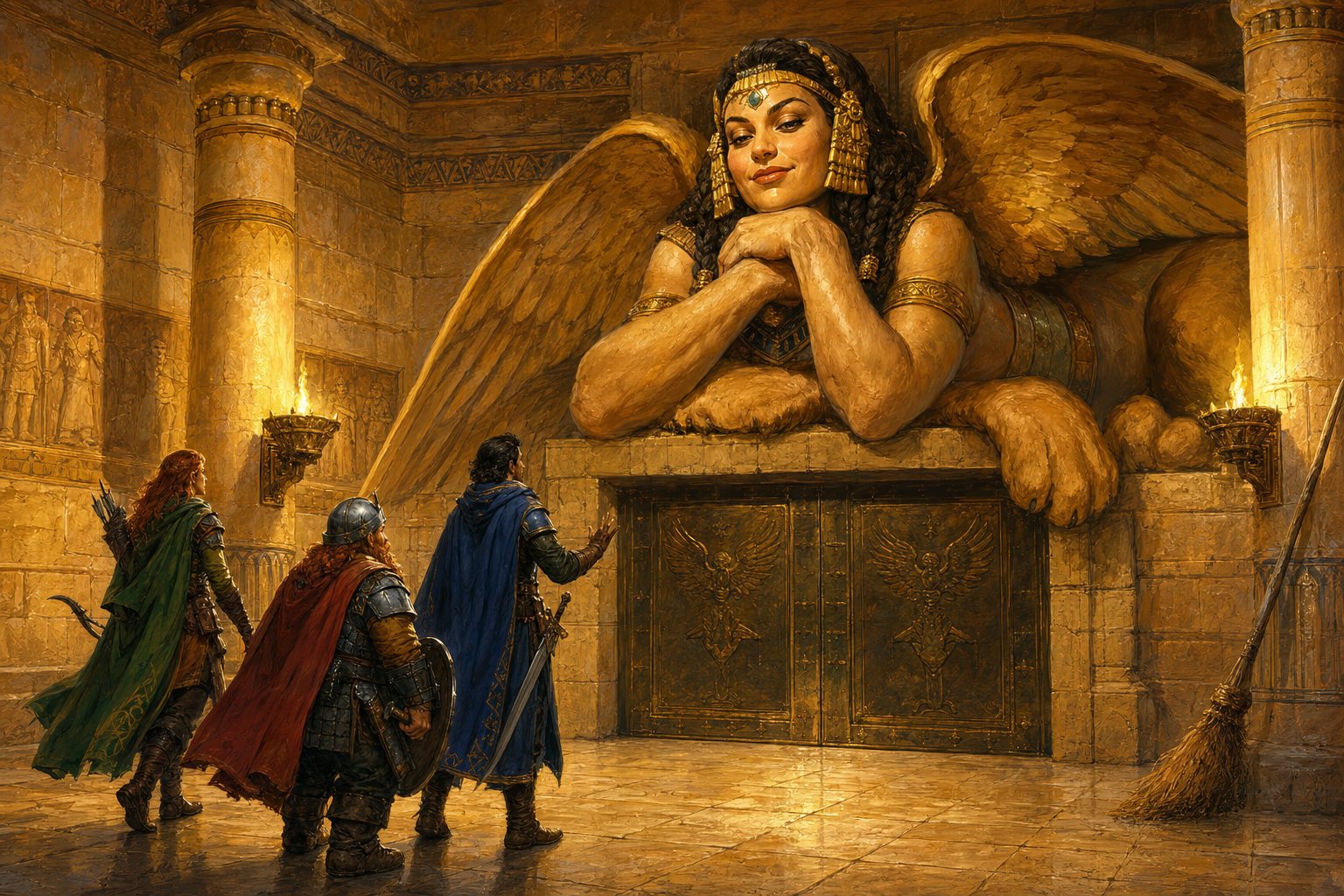
The chamber is swept. That is the first thing you notice — after all this maze, a floor with no dust on it — and the second is the wind, which comes up out of the floor itself, warm and smelling of thyme and rain, from the seams of a great bronze door set flat in the stone like a cellar hatch.
She is lying on it. Lion-bodied, folded, chin on her forepaws, wings tucked, and she has clearly been lying there a very long time. Her eyes open before you have finished coming through the arch.
"Three," she says, comfortably. "Then one of yours. Then we will see."
DM summary. The way out is a door in the floor, and there is a sphinx on top of it who will move for a right answer and for nothing else. Combat here is the failure branch and it is priced like one.
The Boon
The Second AnswerOptional knowledge
One of her three riddles arrives already answered, and she can be asked to trade another
What it is. Two sentences in charcoal on plaster, at the height of a person sitting down with their back to a wall, under a tally of thirty-one strokes: She asks the same three. The second one is the smell. No name, no date, no explanation. The Second Answer is what a previous tribute worked out and spent their last hour writing down for whoever came next.
Where it comes from. Early plant: a lore room wall, a dead scholar's notebook with the two lines and she repeats in the margin, a captive in a resupply room who says it once, like a password. Read the words out and move on; do not say who wrote them. Late plant: the last dark passage before this swept room, or the underside of the top question-step — free to anybody who looks at their feet while being brave.
What it does here. Riddle the second — the one everybody takes and nobody carries — already has the smell on its list, the answer she likes best. That is a third of the puzzle in hand before she opens her mouth, at no check and no cost to the three questions. The first line of the scratch is worth more. She does ask the same three, in the same order, and has for four hundred years, so a party can say so — being recognised delights her. Asked, she will set one riddle aside and ask a different one of her own instead, once.
What it doesn't do. It does not answer her first or third, and it moves no number: the lintel is still Investigation DC 15, the traditional set History or Arcana DC 17, Set a Riddle DC 17 if it comes to claws. A trade is a gamble, and she says so if asked. It is worth nothing once the bargain is broken. A party who never found it answers all three cold, with concede all three still open.
Card and numbers or jump to the card ↓
Arena
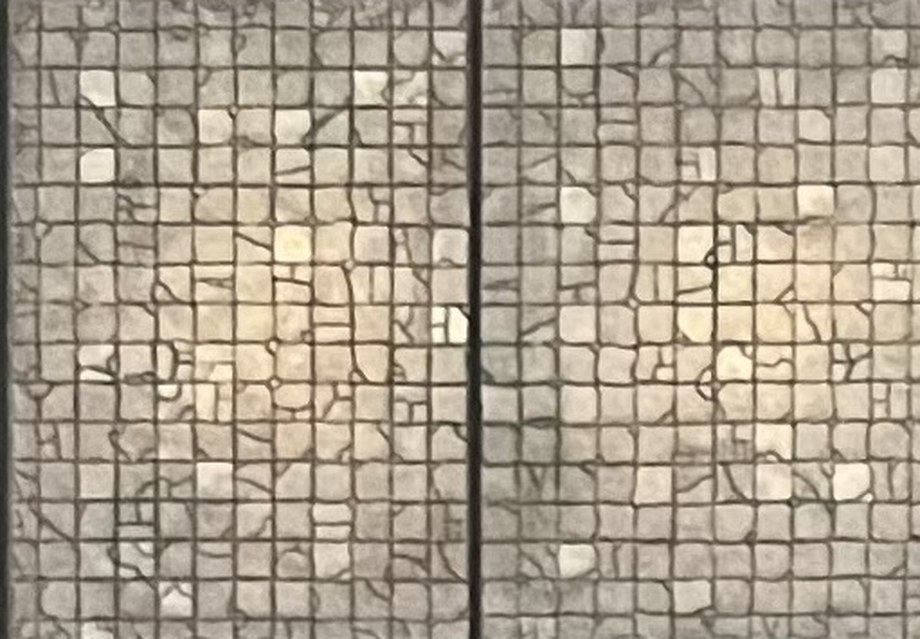
Battle map: The Grey Flags — pages 1 & 2, 110 × 75 ft
The clean court is her room: 70 × 70 ft of swept stone, the only clean floor in the maze, printed. Draw the 12-ft bronze door flat in the centre, the four steps down at the south, and nothing else — the emptiness is the encounter's furniture.
- Dimensions. 70 ft × 70 ft, ceiling 35 ft, entered down four steps at the south. Square, swept, and lit — the only clean room in the maze.
- Light. Bright. Four hanging lamps she keeps filled, and daylight-coloured air coming up through the door seams.
- The Last Door. Bronze, 12 ft square, set flat in the centre of the floor, hinged on the north edge. It is the way to the Resolution and the party can see the light around its edges. While the sphinx is on it, it does not open — she weighs the better part of a ton and she is not obliged to move.
- The answer, underneath. The door's outer face is engraved, and what is engraved on it is her three riddles and their answers. She is lying on the answer key. Nobody who has not moved her can read a word of it, and she thinks this is very funny.
- The lintel. Above the south arch, under a century of soot, a mason has cut: SHE WILL NOT LIE AND SHE WILL NOT MOVE — MIND WHICH ONE YOU ARE ASKING FOR. Investigation DC 15 to read it, and it is worth a free re-ask.
- The question-steps. Four broad steps down from the arch. Standing on the top step is the formal position of an answerer; the hounds will not touch anyone standing there and speaking. It matters: it gives a nervous player a physical place to be brave from.
- The alcoves. Eight niches around the walls at head height, each holding one object left by someone who answered wrong: a sandal, a surveyor's chain, a child's clay bull, a legionary's dog-tag in a script nobody here can read. Nothing in them is trapped. They are just sad.
Roster & Budget
One sphinx, two hounds, and a voice — and none of it fights while anyone is still answering.
| Count | Creature | XP each |
|---|---|---|
| 1 | The Sphinx of the Last Door (boss) | 7,200 |
| 2 | Riddle-Hound | 1,100 |
| 1 | Whispering Laurel | 1,800 |
Base 11,200 XP; ×2 for four bodies = 22,400 adjusted, against the APL 9 Deadly budget of 14,400. Over by half, deliberately: this is the failure branch of a puzzle, and it should read on the page as a bad trade.
The honest smaller number matters more. The hounds will not attack anyone who is still answering a question, and the laurel does not fight at all until its lie has been called. A party that keeps talking while it fights faces the sphinx alone: 7,200 adjusted, exactly half the Deadly budget, and a very survivable twelve minutes.
Phases / Clock
| Phase | Trigger | What visibly changes |
|---|---|---|
| 1 — The Asking | On arrival | She asks three. Nobody rolls initiative. The hounds sit. The laurel murmurs from its alcove and lies exactly once |
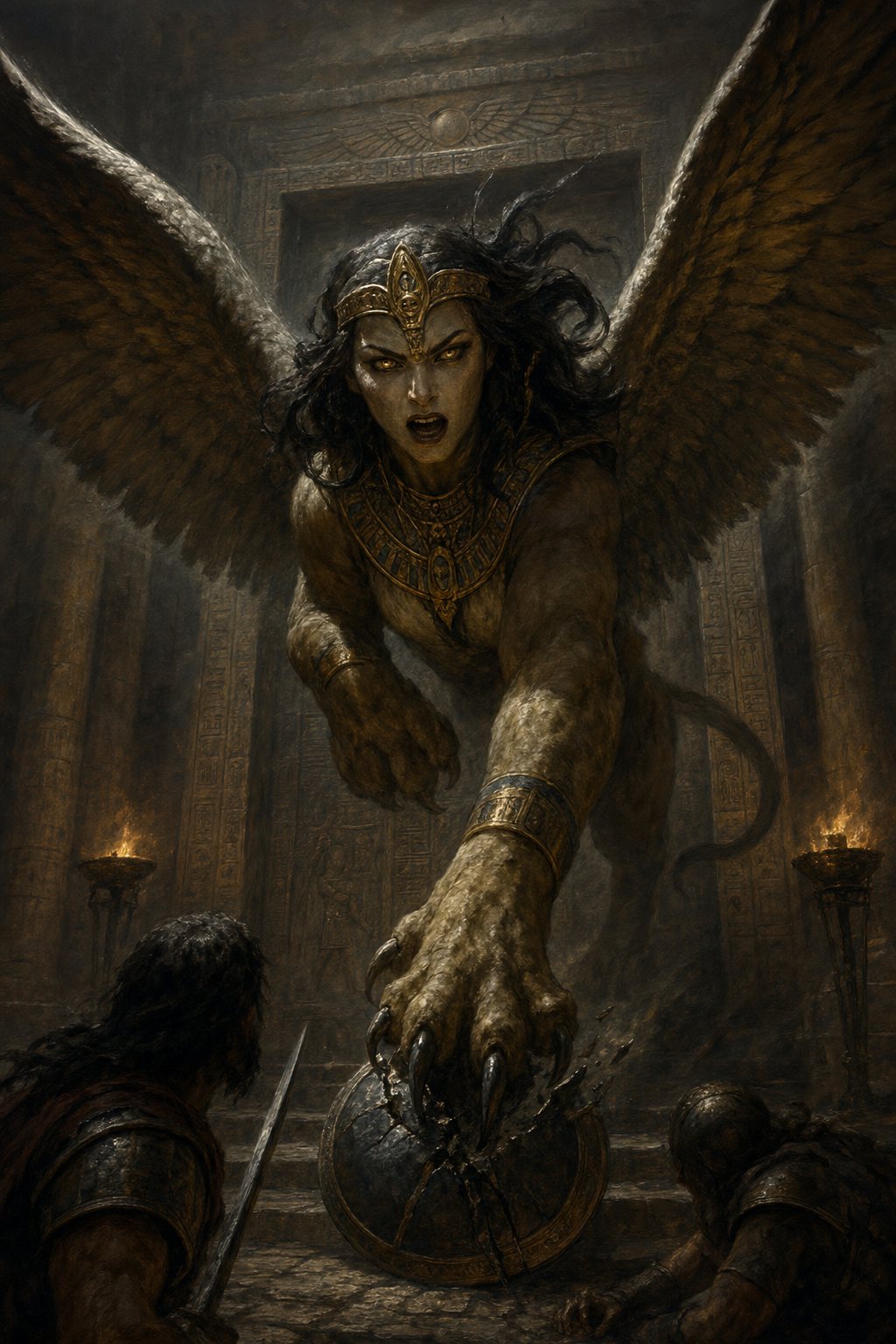
| 2 — The Broken Bargain | Any attack, or a third wrong answer, or an attempt to lever the door while she is on it | She stands — and she says, out loud, "That was the bargain, and you have broken it" before she strikes, because she always says it first. The door is now visible and shut, and it begins to seal: ten rounds, after which the bronze irises drive home and the door will not open again until she settles back onto it |
| 3 — Settling | She drops to a quarter HP, or the party gives a right answer mid-fight | She stops. Sphinxes do not fight to the death over a door; they fight until the discourtesy is paid for. She backs onto the door, folds, and asks the remaining riddles as though nothing had happened, bleeding on the bronze |
Round one, if it comes to that. She does not pounce. She takes off, lands on the top step behind the party — between them and the way they came in — and roars the door shut. The party is now inside the room with her, which is what they wanted, technically.
Combat Resolution
Fighting her is legal, expensive, and slower than answering.
- Tactics. She fights between the party and the door, never over open floor. She uses Roar of the Last Door to scatter clusters, then singles out whoever is trying to lever the hinges. She will not use her claws on a creature that is speaking an answer, ever, even a wrong one — that is the rule she lives by, and a party that works it out has found the fight's real lever.
- The hounds circle and harry, going for anyone silent. The laurel passes its voice from alcove to alcove; it cannot be hit until someone works out which crown is speaking (Perception DC 16, and the voice moves).
- The weakness. She answers honestly. Anyone may spend an action to ask her a question mid-fight and she will answer it truthfully — "how do we make you stop" is a legal question, and the honest answer is "give me a right answer or take me off this door." Players routinely fail to try this. Reward it enormously when they do.
- The clock. Ten rounds to the irises. Say the count aloud from round 5. A party that kills her on round 11 has won a fight and lost their way out until someone works the hinge pins loose (Thieves' Tools DC 19, two successes, ten minutes of fiction).
- What winning looks like. She goes to a quarter HP and settles, or she dies — she is a sphinx-as-monster and killing her is permitted. If she dies on the door, the party has to roll her off it: Athletics DC 18, up to four PCs helping, and it takes as long at the table as it deserves to. Four to six rounds, 25 minutes.
Alternate Resolution
The puzzle, and the intended path: answer three, then ask one.
She asks three riddles, one at a time, and waits as long as the table needs. Each riddle takes three accepted answers — anything in the list, in any wording.
Riddle the first. "I am not in the maze, and the maze is in me. What am I?"
- The hill. The rock this whole thing is cut out of.
- A map. Any map, including the one in your head.
- The story. What people in Knossos say about this place.
Riddle the second. "Everyone who leaves here takes me with them, and nobody carries me. What am I?"
- Fear.
- The memory of it.
- The smell. She likes this answer best and will say so.
Riddle the third. "What is the only door that opens both ways?"
- Death.
- A mouth.
- The way you came in.
A clever fourth. Accept any answer a player can defend in one sentence that does not contradict the room. "The door you're lying on" is correct for the third riddle and she will laugh, get up, and count it. If the table lands on something you did not think of and it holds, take it — a sphinx who moves goalposts is a cheat, and a cheat is not memorable.
Then one of yours. For each riddle answered correctly, the party may ask her one question, which she must answer truthfully and completely. She cannot lie and she does not evade; she has been down here since before the maze had its current shape and she knows where the wind comes from. This is where the Resolution's Door-tier clue lives.
Mechanical fallbacks, for a table that does not enjoy riddles — every one of these costs something real:
| Fallback | Cost |
|---|---|
| Read the lintel (Investigation DC 15) | Free, and grants one re-ask on a wrong answer |
| Recall the traditional set (History or Arcana DC 17) | Advantage on one riddle, and she docks you one of your three questions for using a book instead of your head |
| Pay in kind | She accepts an object with a story attached, given honestly, in place of one right answer. It goes in an alcove. She will want to hear the story, and she will know if it is invented |
| Concede all three | Say plainly that you cannot answer. She moves off the door, and lets the party through, and charges them nothing but the knowledge that she was disappointed. This path always exists and should never be hidden from a stuck table |
If the party carries The Second Answer, the second riddle is already in hand — the smell is on the list, and they may give it the moment she stops speaking. The first line of the scratch is the better half. She does ask the same three, in the same order, and a party who says so out loud may ask her to set one aside and take another in its place. She will, once, and gladly: being recognised after four hundred years is the nicest thing to happen to her this century. She asks the substitute of a character who has not spoken yet, by name. A trade is a gamble, and she will tell them so, because she does not lie.
Solved state. She stands, stretches, walks off the bronze, and sits at the top of the steps like a housecat. The door is unlocked, the wind comes up properly, and the way to the Resolution is open.
Scaling — APL 6 / 12 / 15
| APL | Adjustment |
|---|---|
| 6 | Two riddles, not three. Sphinx at −25% HP (126) and no Roar of the Last Door. One hound. All DCs −2, and she offers the lintel hint unprompted |
| 9 | As written |
| 12 | Sphinx at +25% HP (210) and a third legendary action. Three hounds and two laurels, and the laurels each lie once, at different times. The door seals in eight rounds. DCs +1 |
| 15 | Add a Lesser Sphinx on the north side of the door who asks a fourth riddle of her own and disagrees with her elder about whether the party answered it. The boss gains a second phase: at half HP she takes to the air, the room's lamps go out, and she asks her riddles from the dark for the rest of the fight. Door seals in six rounds. DCs +3 |
Exit to the Resolution
- Pacing. 30–40 minutes, most of it talk. Behind schedule: ask one riddle, grant one question, and be generous — that is a complete scene and it will still be the bit they remember.
- Let the players confer. Do not put a timer on the riddles in Phase 1. The entire pleasure of this room is six people arguing about the smell.
- She is not a trap. Play her relaxed, amused, and faintly maternal. She has been asked these three riddles' worth of questions by four hundred years of frightened people and she has no appetite left for killing any of them. The menace is entirely in how easy it would be for her.
- The alcoves are the horror, and they are quiet. The child's clay bull is the one to describe. Do not explain it.
- If one player is dominating, she will name a different PC and address the next riddle to them by name: "Not you. You have had your turn. You — the one who has not said anything." A sphinx is the only creature in this deck that can politely fix your table dynamics for you.
- Clue drip. This finale delivers the Door tier, and she is the delivery mechanism: her honest answer to a good question is the clue. The two hooks she carries best are the wind through the door seams, which is warm, moving, and rising (X17 The Wings of Icarus), and her memory of who cut the shaft and why — she watched them do it (X14 A Thread of Your Own Making, X20 The Bronze Bird).
- Callback. A party that met the Sphinx & Riddlers on the riddle bridge (R009), at the dripping oracle (R044), or in the hall of the hollow chorus (R094) already knows two things: the claws come out only after a broken bargain and only after a warning, and one voice in the room is lying. Both are true here.
Boon Card
The Second Answer
Knowledge · two lines of charcoal on a wall, and what the first one implies · optional, and never on the loot table
Appearance: She asks the same three. The second one is the smell. — under a tally of thirty-one days, at sitting height, in a hand that steadies as it goes · nothing to carry, nothing to lose, nothing to roll
One of Her Three, Already Answered. The smell is an accepted answer to her second riddle and the one she likes best. A party who has read the scratch may give it the moment she finishes asking, with no check, no fallback spent, and no cost to the questions they have earned.
She Repeats Herself. The same three riddles, in the same order, for four hundred years. Anyone who has read the scratch knows it, and she confirms it if asked, because she does not lie and consistency is not a thing she is ashamed of.
Ask Her to Trade. Once, on request, she will set one riddle aside and ask a different one of her own in its place. She agrees gladly and charges nothing — being recognised after four centuries is a compliment — but she puts the substitute to a character who has not spoken yet, by name. A trade is a gamble, and she says so if asked.
It Changes No Number. No DC in this room moves. It grants no advantage, spends no fallback, stacks with nothing, and does not make her easier to hit. The lintel, the traditional set, and every saving throw on her card are exactly as printed.
Worth Nothing After the Claws. Once the bargain is broken there is no riddle to answer and no trade to ask for. The scratch is two lines of charcoal on a wall in another room, and it will not move a sphinx off a door.
Read It Out to Her. Recite the two lines where she can hear them. She recognises the hand, and she will say whose it was and what became of them, truthfully and completely, because she always does. One of the alcoves may become a great deal worse to look at.
Creature Cards
The sphinx is unique to this chamber. Her household is Sphinx & Riddlers (W15) and recurs across the deck, so those numbers live in the bestiary.
Shared across rooms, so the full cards live in the bestiary: Riddle-Hound, Whispering Laurel. Every mention above opens the numbers here on this page.
The Sphinx of the Last Door
Large monstrosity, lawful neutral · CR 11 (7,200 XP)
AC 17 (natural armour) | HP 168 (16d10 + 80) | Speed 40 ft., fly 60 ft.
Saves Dex +7, Int +9, Wis +9, Cha +8 · Details Arcana +9, History +13, Insight +9, Perception +9 · Immune to psychic, charmed, frightened · Magic resistance · Truesight 120 ft.
She Will Not Move. While she is lying on the Last Door it cannot be opened, lifted, levered, or teleported through. She weighs 900 pounds and she is not required to be reasonable about it.
She Will Not Lie. She answers any question put to her truthfully and completely, including during combat, and answering costs her nothing. She is not obliged to volunteer anything, and she does not consider silence a lie.
Claws Only After a Broken Bargain. She makes no attack until she has said aloud that the bargain is broken, and she never attacks a creature that is in the act of speaking an answer, however wrong the answer is.
Legendary Bearing. She takes two legendary actions per round, spent at the end of another creature's turn, and regains them at the start of hers.
Multiattack. Two claw attacks, or one claw attack and one use of Set a Riddle.
Claw. Melee, +9 to hit, reach 5 ft, one target. Hit: 16 (2d10 + 5) slashing damage.
Set a Riddle. One creature within 60 ft that can hear her makes a DC 17 Intelligence saving throw. On a failure it is caught on the question: it takes 22 (4d10) psychic damage and cannot take reactions until the end of its next turn. On a success it takes half damage, and if the player offers any answer at all out loud it takes none.
Roar of the Last Door (recharge 5–6). The bronze under her rings. Each creature within 30 ft makes a DC 17 Constitution saving throw, taking 27 (6d8) thunder damage and being pushed 15 ft on a failure, or half as much and no push on a success. Loose objects and unattended lamps are thrown from the alcoves.
Correction. When a creature within 60 ft states something she knows to be false, she may say the true version. The speaker makes a DC 17 Wisdom saving throw or has disadvantage on its next attack roll or ability check, because she is right and everyone heard.
Wingbeat. She flies up to 30 ft without provoking opportunity attacks, and the lamps gutter.
Ask Again. She repeats a riddle to one creature within 60 ft. That creature makes a DC 17 Charisma saving throw or must spend its action on its next turn attempting an answer.
Settle. Costs 2 actions. She returns to the door and lies down on it, ending her Phase 2 clock and resetting the seal. Use this the moment a party gives a right answer mid-fight.