The Bone Orchard Lift
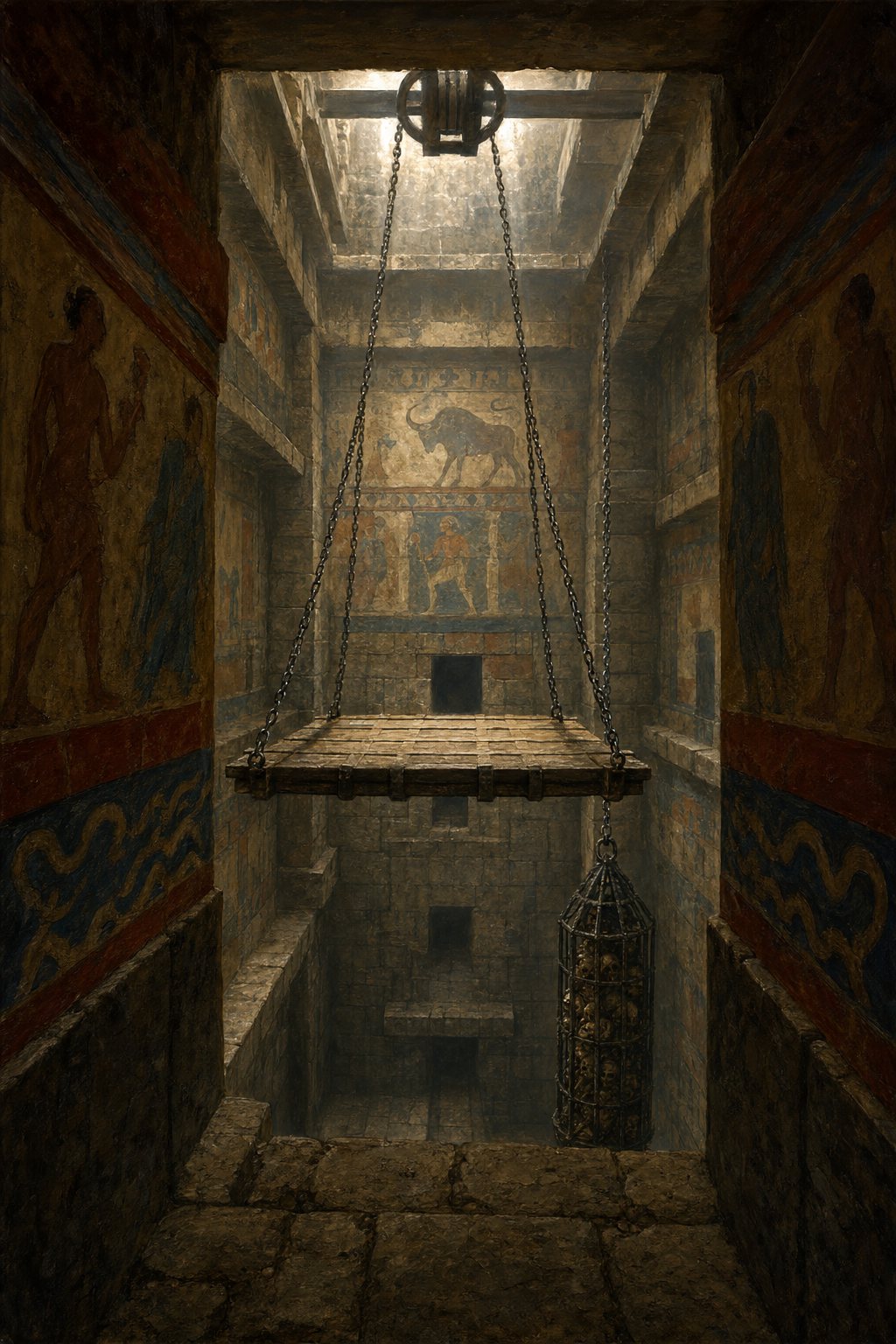
A shaft, forty feet down and forty feet up, and hanging in the middle of it a platform of planks and chain wide enough for six. The chain runs up over a wheel at the top and back down the other side of the shaft, and on that end hangs the counterweight: an iron cage, taller than a man, packed with bones.
The cage is not full. Somebody has been taking bones out of it, and the marks in the dust say they took them that way, towards the low arch, and did not come back.
DM summary. A counterweight lift that will not move because someone scavenged the counterweight. The party has to put roughly a hundred pounds of somebody back in a cage to get the platform to lift, and the only bones available are the ones underfoot.
Terrain & Features
Battle map: custom map. A 30 × 30 ft shaft head with 80 ft of vertical lift machinery — sketch the galleries and track the platform's height beside the map. Browse the book if a page half fits your table better.
- Dimensions. 30 ft × 30 ft of floor and 80 ft of shaft: ceiling 40 ft above the entry gallery, floor 40 ft below it. The party arrives on the upper gallery, a stone ledge 6 ft deep running along the east wall.
- Light. Dark. There is no light source in this room at all, and nothing here glows. Say so before anyone rolls anything; a party without a light is solving this by feel, which is a legitimate and horrible way to spend ten minutes.
- The platform. Planks and chain, 8 ft × 8 ft, currently level with the upper gallery and held there by a hand-brake. It carries six people comfortably and eight badly.
- The counterweight cage. Iron bars, 4 ft × 4 ft × 7 ft, hanging at the bottom of the shaft on the other end of the chain. Its door is a hinged panel with no lock. It weighs 900 lb as it stands.
- The orchard floor. The bottom of the shaft, 40 ft down, is knee-deep in bones — hundreds of individuals, sorted at some point long ago into long bones, ribs, and skulls, in three heaps. This is where the counterweight material is.
- The brake. A timber lever at the gallery rail. Released, the heavier side goes down. There is no ratchet and no half-measure: the lift moves until something stops it.
- The bones move. Not much. When the party is quiet, a rib settles somewhere in the dark. Nothing in this room animates. No fight starts here at any point, in any circumstance, and you should hold that line even if the table is certain otherwise — the tension is the payment.
Traps / Puzzles / Checks
The arithmetic, which the room states in the open. The lift moves when one side outweighs the other by 100 lb or more. The cage is 900 lb. Six adventurers with kit are roughly 1,200 lb, which is 300 lb too much on the platform side: step on together and the platform drops like a stone, hits the bottom at speed (Dexterity save DC 13, or 2d10 bludgeoning and prone, everyone aboard) and the cage slams up into the wheel and jams, which ends the puzzle badly.
| Element | Value |
|---|---|
| Read the balance | Investigation DC 12 at the rail, or free for anyone who states they are weighing it up. The chain has load-marks stamped on the links in hundredweights |
| Weigh the party | No check. Ask the players. Six PCs in kit is 1,200 lb; adjust for your table's actual party |
| One armful of bones | 60 lb. A character can carry three armfuls at a time up a ladder, or six in a cloak dragged behind them |
| Load the cage | The cage takes twelve armfuls before the door will not shut. Loading is unhurried work and takes one minute per three armfuls |
| Solved state | Cage between 1,100 and 1,300 lb — five to seven armfuls — and the platform descends smoothly under a full party, landing soft, with both lower exits reachable |
Two ways down that are not the lift.
- Ride it in two loads. Three people at a time is 600 lb; the 900 lb cage drops and the platform rises, which takes the first group up to the top gallery instead of down. That is not a failure — the top gallery has an exit — and a party that works it out has solved the room a different way.
- The chain. Climb the counterweight chain 40 ft: Athletics DC 15, with a fall of 4d6 at the midpoint. The chain is greasy and it is the mechanical fallback for a party with no patience and one good climber, who can then load the cage from below while everyone else waits.
The scavenger. Down among the long bones, Investigation DC 13 finds the person who was taking them: a body in a leather apron with a hand-cart, a broken ankle, and a bone saw. He was making something out of the counterweight and the lift stranded him. His cart holds two armfuls, already sorted.
Exits
None. The scavenger had nothing but tools, the bones have been picked over by someone with a saw and a plan, and the cage is iron bar that nobody is carrying out. If your table looted the body and found nothing, tell them so cheerfully; this room's payment is the exit and the choice of which direction to take it.
Scaling — APL 6 / 12 / 15
| APL | Adjustment |
|---|---|
| 6 | The load-marks on the chain are legible without a check, and the cage needs only three armfuls. Climb DC 13, fall 2d6 |
| 9 | As written |
| 12 | The wheel at the top is seized with rust: Athletics DC 16 from the head-house, or Thieves' Tools DC 15 with oil, before the lift will move at all. Other DCs +1 |
| 15 | As APL 12, and the cage's door hinge is broken — bones loaded loose fall out through the bars at one armful per round of travel, so the descent is a timed problem: the party has three rounds of correct balance before the cage lightens and the platform stops halfway. DCs +3 |
- Pacing: ten minutes, twelve if they enjoy the arithmetic. This is a breather room with a nasty texture, and its job is to make the party handle human remains for ten minutes without a monster to blame it on. Behind schedule? The scavenger's cart is already loaded with five armfuls sitting beside the cage — the party tips it in and rides down. Four minutes.
- Give them the numbers. Nine hundred, one hundred, sixty. Write them on a scrap and hand it over. A weight puzzle where the DM keeps the weights is not a puzzle, it is a guessing game.
- If the table wants to skip it, the chain climb is right there and it costs one Athletics check and a bit of skin. Never make a puzzle room the only way forward; exit A is behind them the whole time.
- The horror is the paperwork. "Five armfuls" means five decisions about which bones. Ask, once, whose bones they think these were, and then let it go. Do not belabour it.
- Table safety. Handling human remains, and a corpse who starved with a broken ankle forty feet down in the dark. If that is heavier than your table wants, make the scavenger long dead and the bones plainly ancient and non-human — animal bones sown for teeth — with no mechanical change at all.
- Clue drip. Two objects: the scavenger's own tally, cut into his cart's handle — five marks, then a gap, then one more, which is a man counting days (X14, a surveyor's habit in a man who was not a surveyor), and the saw itself, which he was using to cut long bones down to a wing-spar length and had nearly finished three matched pairs (X17).
- Callback. Sown Bones (W01) is the deck's most-fielded warband and this is the room where it does not attack. If your table has fought a shield wall of these already, the twenty minutes of quiet spent shovelling their cousins into a cage will do more for the maze's atmosphere than another fight would.