Hall of the Hollow Chorus
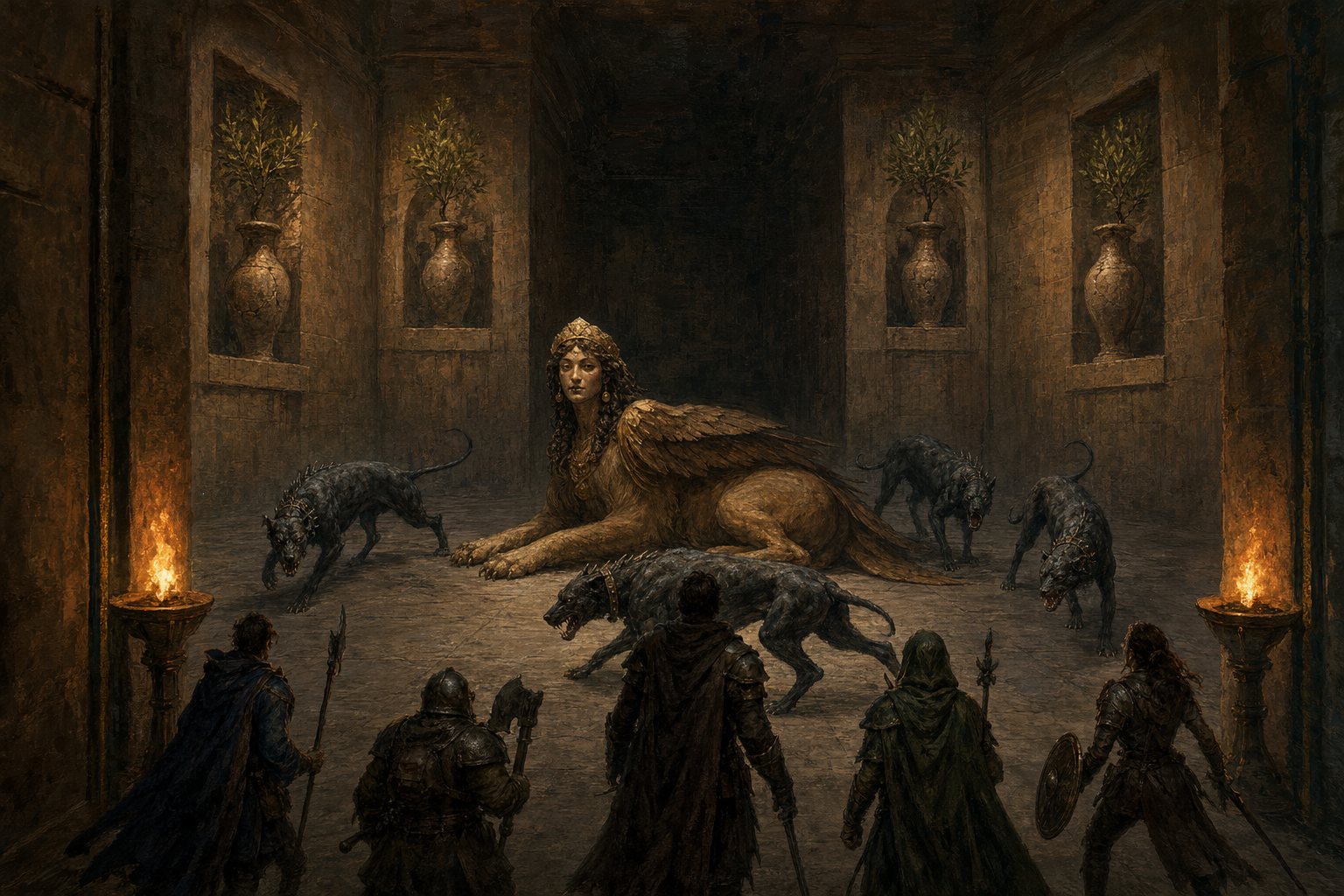
The hall is big enough that your light does not find the far wall, and the floor is smooth, and swept. Three stone stalls are cut high in the walls, the kind a choir stands in, and each holds nothing but a laurel tree growing from a cracked stone urn. Two long-legged hounds lie in the middle of the floor with their chins on their paws, watching you come, not getting up.
A voice from the first stall says: "Ah." A second, from across the hall, says: "They have come in the middle." And a third, from directly behind you, where nobody is standing, says: "Then we begin again from the top."
DM summary. Three singing laurels in the middle of a performance, two hounds that will not interrupt anybody who is talking, and a toll paid in answers. There is a riddle, there is a liar, and both have written solutions. The fight exists and is Deadly, and the party has to work quite hard to earn it.
Terrain & Features

Battle map: The Grey Flags — pages 1 & 2, 110 × 75 ft
The blank full spread is the chorus hall: 80 × 60 ft of open, echoing floor with nothing to hide behind, which is the point. Chalk the three lectern stalls high on the walls (25 ft up) and the two hounds at centre.
- Dimensions. 80 ft × 60 ft, ceiling 40 ft. Open floor, nothing to hide behind, and an echo that returns a spoken word about a second and a half later.
- Light. None, and the hall eats it — a lamp lights 20 ft here rather than
- The stalls at 25 ft up are outside any torchlight the party is carrying.
- The three stalls. Carved niches high on three of the four walls, each fitted with a stone lectern, a worn place where feet stood, and a laurel growing from a cracked urn. Nobody stands in them, and all three are occupied.
- The echo. Any creature trying to locate the speaking crown by sound does so against the echo: the speaking crown can be fixed by spending an action listening, Perception DC 15, and only until the end of that PC's next turn.
- The hounds. Two, in the middle of the floor, entirely visible, entirely relaxed. They will not attack anyone who is speaking an answer to a question the chorus has put. They know this rule better than the party does and they wait with the patience of something that has waited before.
- The swept floor. Somebody sweeps this hall. There is a besom leaning in the corner, and no dust at all, in a maze made of dust.
Bypass Options
The hounds cannot attack a creature that is speaking an answer to a question the chorus has asked. Rambling counts. Stalling counts. Being wrong counts.
- How it runs: the party nominates an Answerer. On each of that PC's turns they must actually say something aloud at the table, in character, addressed to the chorus. Charisma (Performance or Persuasion) DC 12 to keep it going without repeating themselves; a party may hand the role off mid-round, and the handover is free if the next speaker begins before the last one stops.
- Success: the whole party crosses the hall unmolested while the Answerer talks. The choristers are charmed by the effort and will not begin anything.
- One failure: the Answerer dries up. The hounds are free for one round and they use it — one bite each, at the nearest target, and then they wait again as soon as someone starts speaking.
- Two failures: the antiphon breaks. Roll initiative, and give the party one round in which starting to talk again still stops the hounds.
Answer the riddle, or name the liar, or pose a riddle they cannot solve.
- DCs are in the checks below. Any one of the three settles it.
- Success: the chorus sings the party across. They are escorted, out loud, in three-part harmony, all the way to whichever exit they choose — which is ridiculous and delightful and worth playing straight.
- Failure: the toll is unpaid but not defaulted; the party may still take the first or third bypass, or leave.
The hardest and the most elegant. A chorus needs a respondent.
- The rule: if no PC speaks aloud from the moment they enter, the antiphon cannot begin. The hounds watch and do nothing; they have no instruction to act against people who are not part of the performance.
- The test: at the hall's midpoint the third voice asks each PC one direct, personal, unfairly well-informed question — "Your mother wants to know whether you are eating." Each PC makes a Wisdom save DC 13. Failure means they answered, out loud, before they could stop themselves.
- One answer given: the chorus has its respondent and the parley begins normally, from the top, with the party standing in the middle of the floor.
- What it costs: silence means no toll paid, no riddle, no liar named, and no clue drip. It is the fastest route through this room and the emptiest, and you should let a party take it without penalty and without applause.
Encounter
Only if the parley fails, and it takes real effort to fail it.
| Count | Creature | XP each |
|---|---|---|
| 3 | Whispering Laurel | 1,800 |
| 2 | Riddle-Hound | 1,100 |
Base 7,600 XP; ×2 for five bodies = 15,200 adjusted, against the APL 9 Deadly budget of 14,400. Over budget, in an open hall, against three things that are invisible, incorporeal, and resistant to nonmagical weapons. Take this fight seriously or, better, do not take it.
Why they are not attacking. They are in the middle of an antiphon and the antiphon is not finished. The chorus begins again from the top when interrupted, which is what has just happened, and the party is now — as far as three disembodied voices are concerned — part of tonight's performance. The hounds will not interrupt an answer, and someone is nearly always answering.
What triggers it. Attacking anything; refusing to answer and crossing the hall; or answering the riddle wrong three times, which is hard to do by accident because the chorus keeps offering hints it considers generous.
Round 1, if it starts. All three laurels use Riddling Chorus if it is available and otherwise pass their voices crown to crown across the hall. The hounds go for whoever stopped talking first. The party's problem is that they cannot see, hit, or reliably target anything, and the answer to that problem is in the parley section, not in their spell lists.
If the party fights anyway. They can lose people here. The one honest route through the fight is the same route as through the conversation: catch a laurel in its lie. A laurel proven false is stunned for a round and loses every damage resistance for a minute, and it is the only reason this encounter is winnable at all. Say that out loud through a Riddle-Hound's behaviour rather than as a rules lecture — the hounds visibly flinch when a voice is contradicted.
Withdrawal. The party may withdraw by the way they came at any point, mid-conversation or mid-fight. Nothing here pursues: the hounds will not leave the hall and the laurels have a performance to finish. The cost is the toll's reward, the clue drip, and the fact that the chorus will remember them as the ones who walked out during the second strophe, which is the worst thing you can be to a choir.
Traps / Puzzles / Checks
The toll: one riddle, three accepted answers. The second voice asks it, and the hall goes quiet enough to hear it twice because of the echo.
"I grow larger the more you take from me. I disappear the moment you fill me. Cut me deeper and I am only more myself. What am I?"
- Accepted: a hole. a grave. a well (or a pit, a shaft, a mine — any dug void).
- Accept a clever fourth. A debt, a wound, a hunger, and this maze are all good enough if the player argues them in one sentence. The chorus is not a lock; it is an audience, and an audience rewards a good line. When in doubt, take the answer and have the third voice say "…that is not what we meant. It will do."
- Wrong answers cost nothing the first two times except a verse of mockery. The third wrong answer, with no reasoning offered, ends the parley.
- Mechanical fallback: a party with nobody willing to guess may pay in kind instead — any PC who poses the chorus a riddle it cannot solve buys the same passage. Give them one attempt, judge it generously, and if it lands, the chorus is delighted and says so.
The liar. Before the riddle, each voice makes one claim. By the chorus's own custom only one lie may be spent before the toll is settled, and exactly one of these three is false.
| Voice | Claim |
|---|---|
| First | "Two of us will let you pass for an answer. The third wants no answer at all." |
| Second | "The first of us has spoken falsely tonight." |
| Third | "I have not lied to you, and neither has the second." |
- The solution is the first voice, and it is deducible: if the second were lying, the third's claim would also be false, which is two lies; if the third were lying, the second's claim would also be false, which is two lies. Only the first works. Let the players talk it through — it takes a table about ninety seconds and it is enormously satisfying.
- What the lie was hiding: the truth is kinder than the threat. All three will let the party pass for an answer. There was never a third voice that wanted them dead.
- The check route: Insight contested against the laurel's Deception +6, or a flat DC 15 if you would rather not roll for a monster, made immediately after any one of the three has spoken.
- Naming the liar correctly: that laurel is stunned until the end of its next turn and loses all damage resistances for 1 minute, and the chorus waives the toll entirely out of professional respect. Naming wrong costs one use of Riddling Chorus against the party and one more wrong guess is not offered.
Silence. The chorus cannot perform to an audience that will not answer, and it finds that genuinely distressing. That is the third bypass above, and the Wisdom save that breaks it is stated there.
Exits
None. Three voices own nothing. The stone lecterns hold nothing, the stalls hold nothing, and the besom in the corner is a besom. If a player insists on searching the hall for twenty minutes, the chorus will describe, in detail and in harmony, everything they are failing to find.
Scaling — APL 6 / 12 / 15
| APL | Adjustment |
|---|---|
| 6 | Two laurels, one hound, and the liar's claims are simplified to two voices — the first lies, the second says so. All DCs −2 |
| 9 | As written |
| 12 | Three laurels, three hounds, and a Lesser Sphinx presiding from the fourth wall that does not have a stall. It does not fight unless the chorus is attacked, and it says so first. DCs +1 |
| 15 | As APL 12, plus each laurel spends its own lie — three lies among three voices, which makes the deduction genuinely hard — and Riddling Chorus recharges on 4–6. DCs +3 |
- Pacing. Fifteen to twenty minutes, nearly all of it talking, and it will run long if the table enjoys logic puzzles. Behind schedule: cut the liar entirely, ask the riddle, accept any reasonable answer, and be out in six minutes. Cut the riddle instead of the liar if your table prefers deduction to wordplay — the room works with either half removed.
- Voices, not monsters. Do three different voices if you can, badly if necessary. Put the first voice behind the players, the second across the hall, and the third directly behind whoever is speaking, and move it. This room is a performance and the DM is in it.
- Write the three claims on an index card and hand it to the table. Logic puzzles delivered aloud are unfair; the same puzzle on paper is a table favourite.
- If nobody bites, the chorus starts offering hints, because it wants the performance to go well. It is not adversarial. Its opening threat was the lie.
- Clue drip. Two objects here take a clue well: the besom in the corner, which means somebody with hands comes here and sweeps, and suits X05 (Carry Them Out) or X10 (Ariadne's Thread); and the worn place in the third stall, where somebody living stood long enough to wear the stone, which suits X06 (The Oracle's Bargain).
- Table safety. The third voice's personal question is designed to be uncomfortable and to be about family. Give the players the option to have it be trivial instead — "Your mother wants to know if you are eating" lands differently for different people, and the save works just as well if the question is about a debt or a dog.
- Warband callback. Sphinx & Riddlers always talk first and always tell you the rule before they break you with it. A party that has met them will know to keep talking, and this room rewards that knowledge more directly than any other in the deck.
Creature Cards
Both belong to Sphinx & Riddlers (W15) and recur across the deck, so the numbers live in the bestiary. The tactics above are this room's and stay here.
Shared across rooms, so the full cards live in the bestiary: Whispering Laurel, Riddle-Hound. Every mention above opens the numbers here on this page.